

Jungfateh Singh
January 16, 2026 | 5 min. read | Opinion
There is a moment in every community’s life when the question stops being whether the state can protect you, and becomes whether the state has decided you are acceptable collateral. British Columbia is living through that moment now. When an RCMP national security assessment describes the Lawrence Bishnoi crime group as a violent organization “acting on behalf of the Indian government,” that is not a routine policing file, and it is not an ordinary headline to be managed. It is a warning about foreign directed violence, coercion, and intimidation unfolding inside Canada. It is the kind of finding that, in any serious democracy, would trigger a hard political response, not a trade delegation and a press line.
What we have instead is a premier and a cabinet minister attempting to recast an explicitly political problem into the language of commerce and administration.
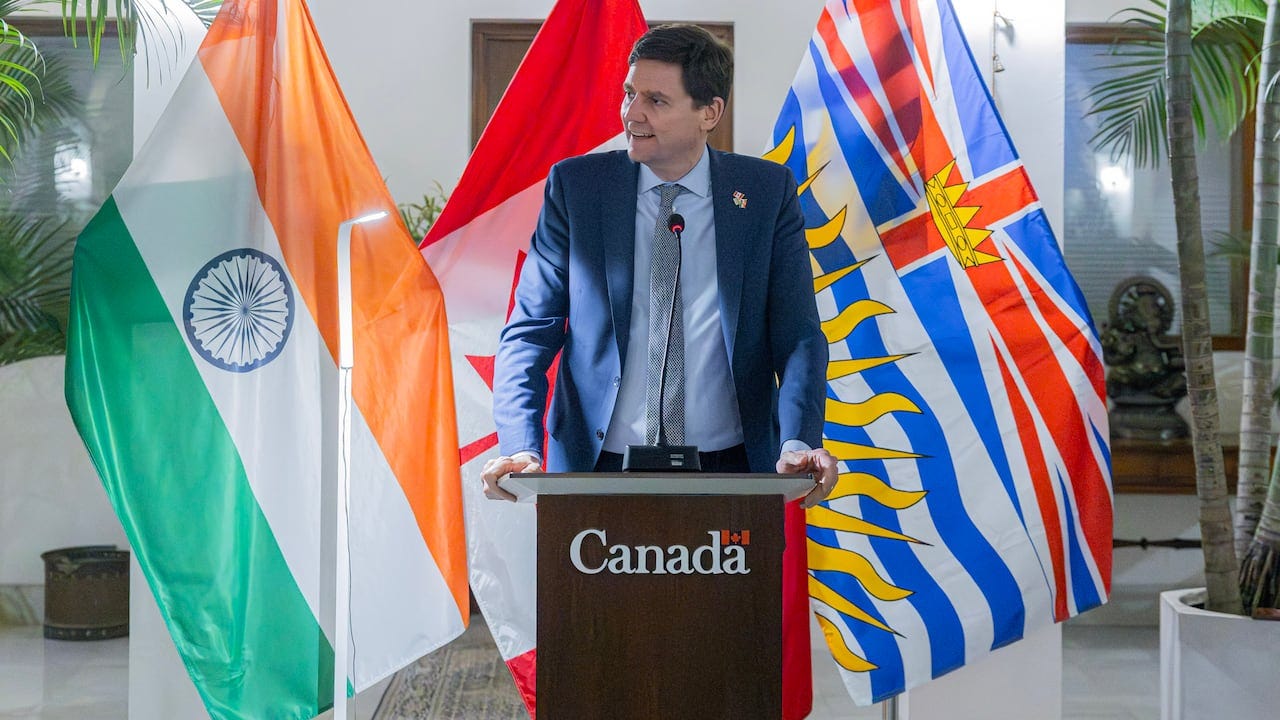
Premier David Eby chose to travel to India from January 12 to 17, 2026, pitching British Columbia’s mining, energy, forestry, and broader economic ambitions as though the central question of our time is market access. The same week, he downplayed the RCMP document, describing the key paragraph as a “summary of publicly available news reports,” and insisting it was “not an RCMP intelligence report.” The problem is not merely that this response is evasive. The problem is that it normalizes the premise that the safety of British Columbians, including Sikh Canadians living under credible threat, can be subordinated to a diplomatic reset.
This is especially grotesque because Eby has already told us, in his own words, that he understands the stakes.
On October 14, 2024, he publicly addressed RCMP allegations and acknowledged that they were not just interference, but credible claims of Indian government involvement in homicides, extortions, acts of violence, and intimidation against Canadians. The RCMP’s public messaging that same day described a significant threat to public safety, and it warned that investigations had uncovered information about criminal activity orchestrated by agents of the Government of India, including links to homicides and violence. You cannot speak that clearly in 2024, then feign uncertainty in 2026 when it becomes inconvenient to the province’s trade branding. That is not confusion. That is a choice.
The premier’s defenders will repeat the familiar script: trade is necessary, diversification is strategic, and British Columbia must protect jobs amid broader economic uncertainty.
The question is not whether British Columbia should trade with the world, or whether diversification is generally wise. The question is whether this particular relationship is being inflated into a moral alibi, as though it is so economically indispensable that it justifies silence, minimization, and political passivity in the face of transnational repression. The province itself has said B.C. origin goods exports to India were worth about $1.3 billion in 2024. That is not nothing, but it is also not the economic lifeline being implied when politicians speak as if India is the single hinge on which British Columbia’s prosperity turns.
The numbers make the reality plain. India represents a small share of British Columbia’s exports compared to the United States, and compared to several other major export destinations. British Columbia’s overall export economy is not held together by this one relationship. You do not endanger lives, soften your language, or launder a national security crisis for a slice of the export picture that remains comparatively modest. And at the national level, India represents a very small share of Canada’s goods exports, which further undercuts the idea that Canada is facing an economic cliff if it insists on accountability.
Meanwhile, the violence that Sikh communities have been warning about is not abstract. Extortion related shootings and intimidation have become a recurring feature of the public record in Surrey and across the Lower Mainland, with victims, families, and business owners forced into a life shaped by risk management.
The premier can insist that the matter is primarily criminal and that processes are underway, but that is precisely the sleight of hand. Law enforcement work is necessary, but it is not sufficient, because the underlying allegation is that the criminality is being directed, enabled, or leveraged by a foreign state. If that allegation is true, the response is not only arrests and investigations. The response is political deterrence, diplomatic consequence, and a public posture that treats Canadian sovereignty as non negotiable.
The federal record, even with its own inconsistencies, makes it harder for British Columbia to plead ignorance. In October 2024, Canada expelled Indian diplomats and consular officials in relation to what it described as a targeted campaign against Canadians by agents linked to the Government of India. In September 2025, the Government of Canada listed the Bishnoi gang as a terrorist entity.
These are not minor gestures. They are acknowledgements that something structurally abnormal is unfolding. Against that backdrop, Eby’s decision to treat a new RCMP assessment as essentially a media artifact is not just unhelpful. It is politically dangerous.
This is where Ravi Kahlon’s role becomes impossible to ignore.
The province’s trade mission messaging frames India as a major market with significant opportunities, while presenting the delegation as practical, job focused leadership. But leadership is not merely the ability to sign memoranda and take meetings. Leadership is the willingness to draw bright moral lines when residents are being intimidated, extorted, and shot at, and when federal policing has publicly described organized crime being used to generate fear in diaspora communities. If the province wants to talk about inclusion, safety, and belonging, it must treat Sikh safety as a real test of those values, not as inconvenient noise in the background of a trade itinerary.
For Sikh Canadians, this should be a clarifying moment, not a despairing one. The point is not to beg for a few kinder sentences from a premier who has already demonstrated he will say one thing when the cameras demand it and another when trade talking points require it. The point is to accept, soberly, that relying on political parties and proximity to power as a substitute for community power has reached its limit. If the province is willing to walk into India for meetings while dismissing national security findings that directly implicate the Indian state’s relationship to criminal proxies, then the Sikh community must be willing to treat that decision as disqualifying.
That is why direct civic action against the BC NDP, including David Eby and Ravi Kahlon, is not extreme. It is civic self-defence, exercised through lawful, disciplined, non-violent pressure. Boycotts, protests, and the refusal to provide community stages, honours, or celebratory platforms are legitimate tools of public accountability when a political class insists on trading away your safety for optics. You do not owe legitimacy to leaders who ask you to accept escalating threats as the price of economic theatre. You organize, you withdraw consent, and you make it socially and politically costly to treat Sikh lives as negotiable.
If British Columbia’s government wants to talk about jobs, prosperity, and the future, it can start by proving that the future includes the people it claims to represent. That means acknowledging what the RCMP has said, in plain language, and acting accordingly, without rhetorical laundering.
Until then, Sikhs in British Columbia should treat this as a lesson in political reality: when faced with a choice between spurious trade theatre and the lives of Canadians, this government has shown what it is willing to sacrifice. The only question left is whether our communities will continue to behave as if that sacrifice is inevitable, or whether we will build the independent power needed to make such choices impossible.
Jungfateh Singh is an organizer, writer and producer, and has worked on Sikh issues across the globe for over 15 years.
Baaz is home to opinions, ideas, and original reporting for the Sikh and Punjabi diaspora. Support us by subscribing. Find us on Twitter, Instagram, Threads, Facebook, and TikTok at @BaazNewsOrg. If you would like to submit a written piece for consideration, please email us at editor@baaznews.org.
The Sikh community - especially the over represented Jatt Sikhs who assume leadership of the community (often with very limited ‘pind da pradhan’ mindset) - have a wrong sense of entitlement . Why should Sikhs expect to be treated preferentially when other communities can use their economic muscle to easily influence politicians? Why hasn’t the Sikh community gained economic , political , cultural or social acceptance to the level of other Desi communities ? How many Sikh owned businesses have grown to national levels ? We need a lot of introspection : why are Sikhs so under represented in high value , high prestige professions such as academia , financial services , legal profession, medicine and engineering ? Why do vast majority of Jatts aim for low end , low prestige jobs ?