


Jungfateh Singh
January 28, 2026 | 10 min. read | Opinion
“In Surrey, I spoke with local media about the Liberal extortion crisis that puts families and small businesses in harms way. After years of soft on crime Liberal policies, criminals are emboldened and communities are left less safe. Crime is up 55%. Extortions are up 330% nationwide and up 500% in Surrey alone.”
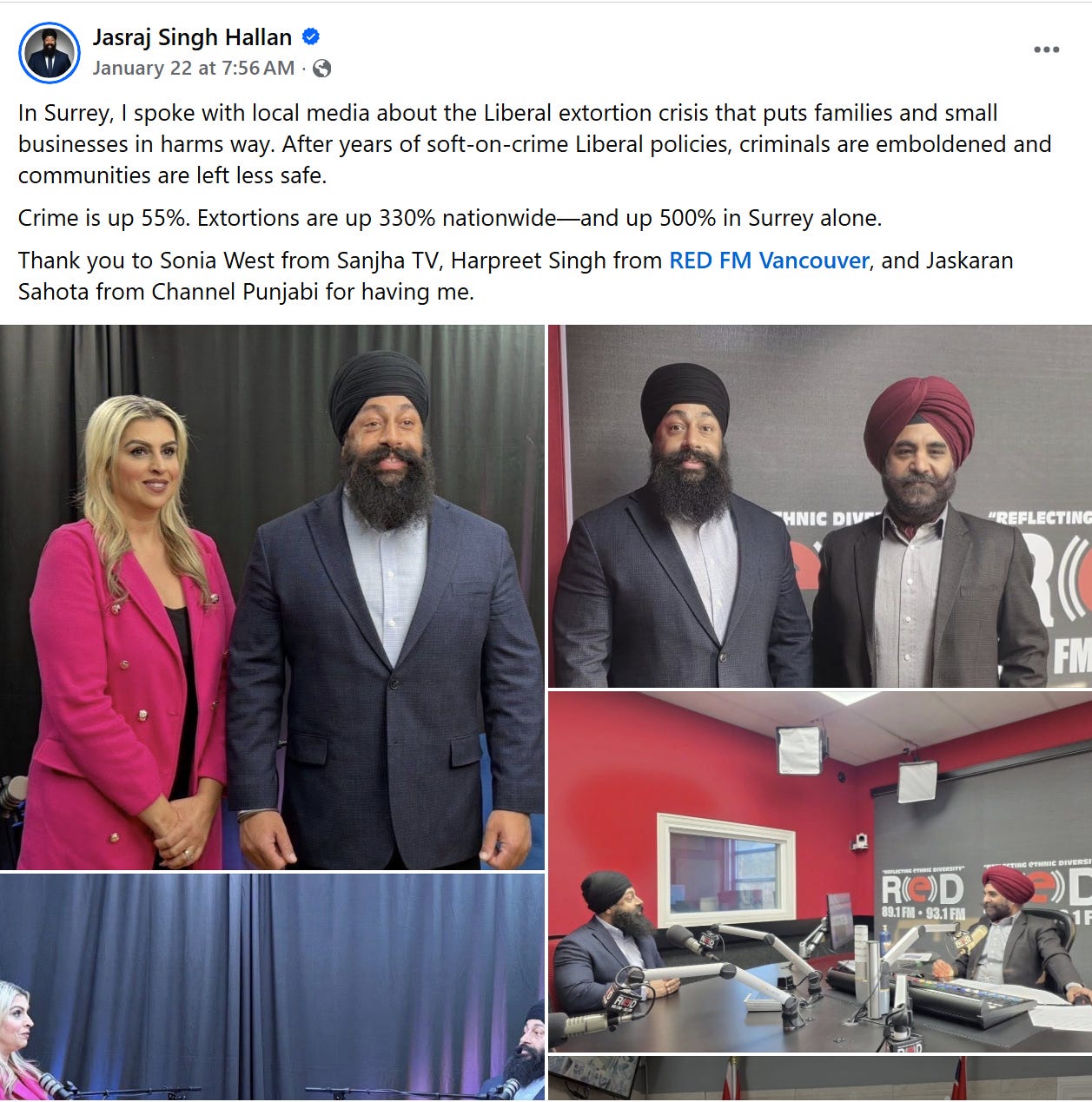
This is the kind of statement that should make every Sikh in Canada pause, not because it is the most outrageous claim in the current political circus, but because it is the clearest window into a deeper betrayal. Jasraj Hallan calls it a “Liberal extortion crisis,” as though what our community is living through can be contained inside a tidy partisan frame, as though a foreign-directed terrorism campaign can be reduced to a domestic morality play about “soft on crime” policy.
That is not a diagnosis. That is evasion dressed up as certainty. It is the comfort of party language replacing the responsibility of naming the truth.
There is a reason this framing is so poisonous. It trains the public to misunderstand the nature of the violence. It turns a community under sustained intimidation into a prop in a parliamentary argument. It directs anger toward the nearest political opponent while refusing to identify the actor that sits at the crux of this crisis, the Indian state, alleged by public reporting and law enforcement assessments to be directing and enabling this intimidation through criminal networks.
If you refuse to name that, you are not merely missing context. You are protecting the architecture of the threat. You are helping it survive.
More than enough evidence has been brought to the forefront to justify a far more pointed and concerted finger at India. Yet MPs like Jasraj continue to obfuscate the issue, because party scripts are safer than political truth.
It is safer to chant “Liberals” than to say “India.” It is safer to talk about “crime” than to talk about foreign direction. It is safer to posture about sentences and bail than to admit that Canada is facing a form of state-sponsored terrorism on its own soil. There is not only an extortion crisis in this country. There is a profound moral crisis being perpetuated by those who claim to represent the community in these political theatres, people who know exactly what they are not saying.
The numbers alone should strip the room of its appetite for games.
Nine hundred plus extortions. Forty-five shootings. Multiple deaths possibly attributed. Those are not statistics you recite for outrage clicks and then move on from. Those numbers describe a community being conditioned through fear. They describe violence used not simply to steal money, but to shape behaviour, to impose silence, to establish control. When that kind of intimidation becomes sustained, the line between organized crime and state-sponsored terrorism begins to dissolve. At that point, it is not enough to say “public safety.” It becomes a question of sovereignty, of whether Canada can admit what is happening and respond accordingly.
Instead, we get this performance, repeated across levels of government, repeated across parties, repeated across social media posts that pretend volume equals courage.
Harman Bhangu begins with the illusion of naming the problem, then pivots to the safest scapegoat available. He writes:
“Surrey Mayor Brenda Locke is calling on Ottawa to appoint an ‘Extortion Czar’ as shootings linked to Indian mafia networks climb toward 1,500 cases nationwide.” The phrase “Indian mafia networks” is placed on the table, and then immediately abandoned.
The real target appears right after: “This isn’t a failure of police. It’s a failure of immigration control and enforcement, where fake documents circulate, deportations stall, and organized crime exploits gaps the government refuses to close.”
He adds, “Officers are doing EVERYTHING they can, but they’re being asked to clean up a mess created by policy.”
Then he delivers the partisan punchline: “The NDP lost control long ago, and now they can’t put the cat back in the bag.”
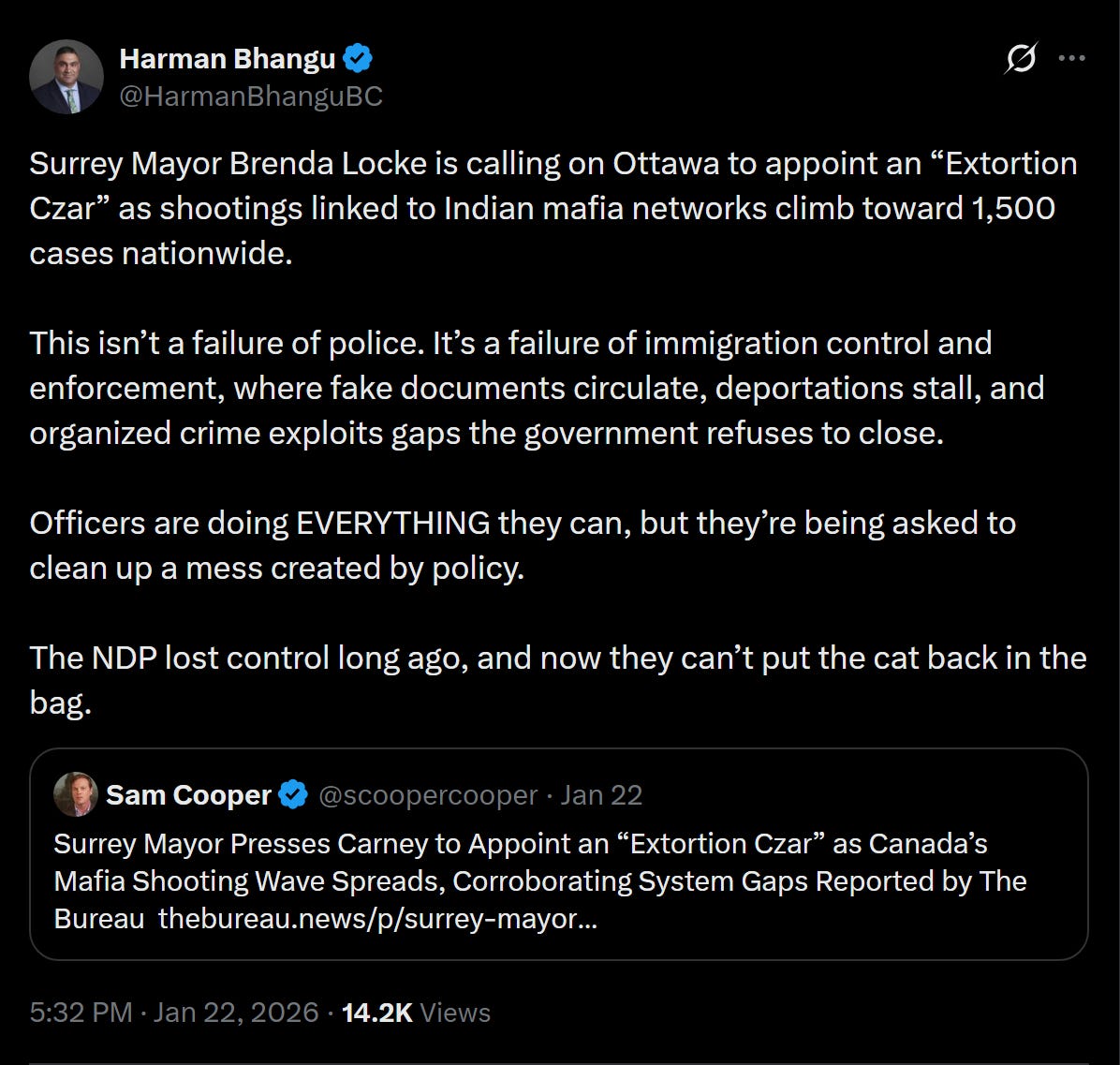
This is not leadership. This is narrative laundering. A foreign element is mentioned just long enough to sound informed, then the audience is marched back into a domestic culture war frame where immigration can absorb the anger and opponents can be blamed. It is a form of politics that is always eager to be seen as decisive, while remaining structurally harmless to the real source of the threat. It produces heat, not clarity. It produces a crowd, not a solution.
Bhangu repeats the same posture in another statement. He writes: “David Eby now says the head of the anti extortion task force should step aside for lacking URGENCY.” Then he turns it into an internal blame ritual: “But Eby appointed the leadership. NIKI SHARMA, as Attorney General and Deputy Premier, oversees the justice system. This happened on THEIR watch.” He escalates the drama: “When homes are shot at and victims fire back, that is a CRISIS caused by political failure.” And then the slogan that pretends to be strategy: “Fix the system. Restore CONSEQUENCES. End the chaos.”
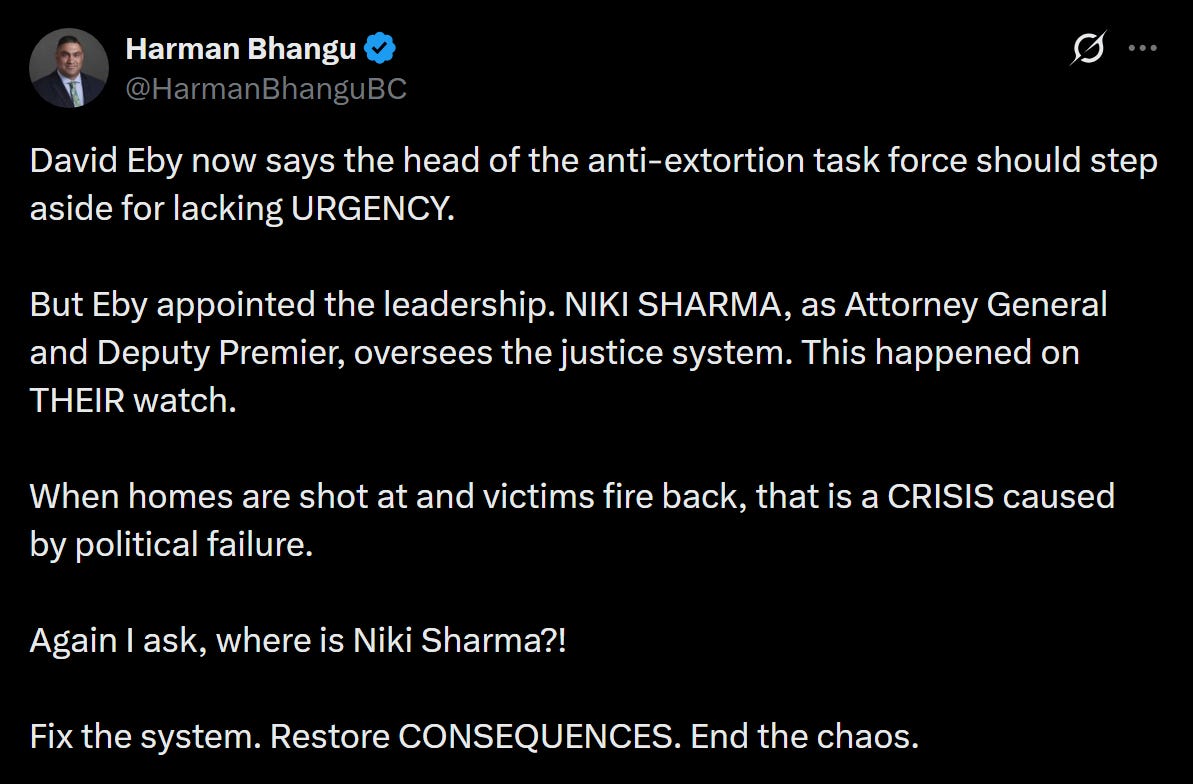
The rhythm is familiar because it is designed to be familiar. It is designed to sound like action without forcing confrontation. It is designed to keep the audience inside a domestic argument where the Indian state never has to be named, and where the crisis can be treated as proof that the opposing party is incompetent. It is politics as spectacle, and spectacle is always easier than truth.
Steve Kooner offers a slightly different performance, but the same avoidance. He states: “BREAKING: Realtors fear becoming extortion targets for their success in BC.” He says a brokerage postponed an awards gala because realtors feared being targeted, then declares: “I’ve been sounding the alarm for months: this extortion crisis is not just a public safety failure, it’s an economic threat.” He warns that “jobs, investment, and livelihoods are at risk,” then asks the predictable question: “Why has the NDP government failed to support victims and their businesses?”
In another statement, he reaches for the language of social breakdown: “The NDP provincial government was warned that public safety under their leadership was deteriorating and that communities were beginning to talk about vigilante justice.” He then offers bureaucracy as a substitute for political clarity, calling for “a dedicated BC Crown Counsel Extortion Team working hand in hand with the BC Extortion Task Force,” and demanding that the federal government “urgently expedite and deploy maximum resources and funding.”
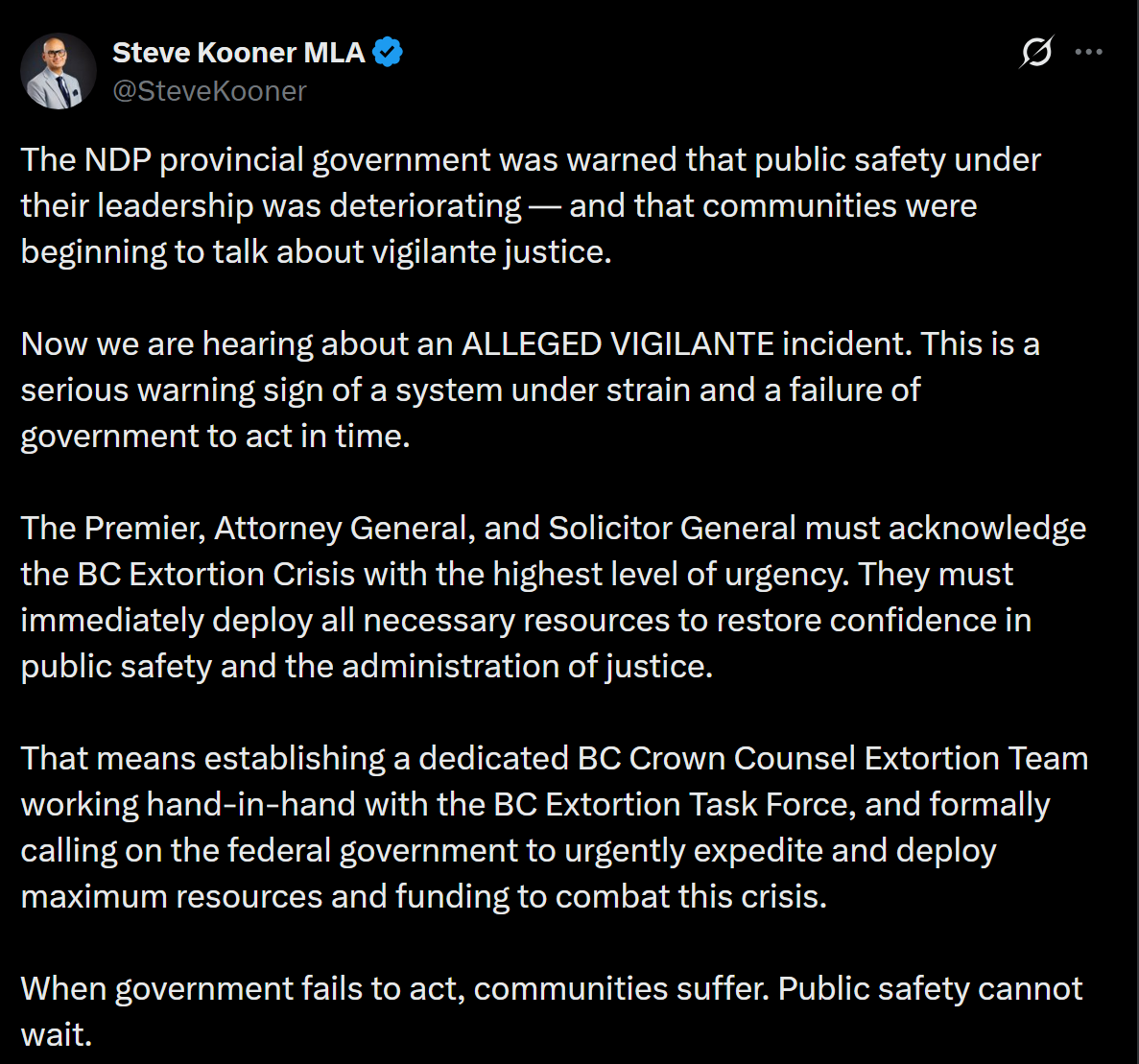
None of this touches the heart of the problem. It is an administrative motion arranged around a political silence. Teams can be formed, units can be announced, resources can be deployed, and yet the crisis will continue to be misdiagnosed if the alleged foreign direction is treated as unsayable. You cannot arrest your way out of a problem you refuse to name properly.
Then we arrive at the federal Conservative messaging, where the crisis is not merely misframed but exploited as a ready made weapon. The party statement declares: “Extortion is up 330 percent since the Liberals took power as their soft on crime, catch and release laws unleashed a crime wave right across our country.” It insists, “Canadians are terrified, and they want action,” then pitches mandatory minimums as the proof of seriousness, along with bail changes, self defence rhetoric, and deportation posturing. It adds an incendiary claim about “18,000 known criminals with convictions” being let into the country. It concludes by scolding the Prime Minister for optics, saying he walked on a pier instead of meeting victims.
Arpan Khanna compresses the entire script into a blunt checklist meant for applause. “Catch and release? Federal. Mandatory sentences stripped from extortionists? Federal. RCMP? Federal. CBSA? Federal. Criminal Code? Federal. Importing 17,800 known criminals? Federal.” Then he concludes, “Do your job.” In Parliament, he repeats the same rhythm, framing the issue as the result of “soft on crime policies,” claiming extortions have “more than tripled,” and asking why the Liberals voted against a Conservative bill “to fight extortion.”
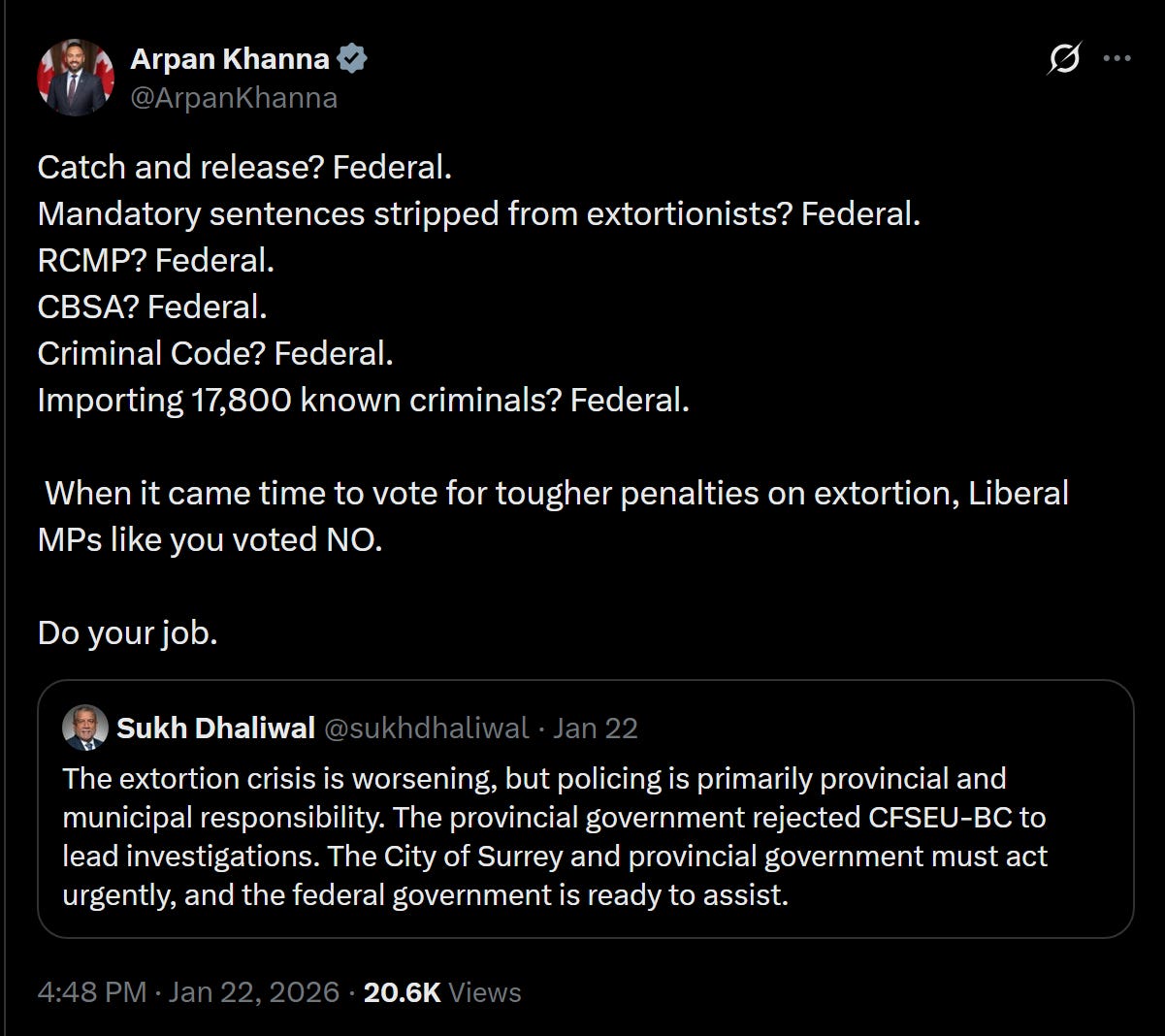
This is the political script in its purest form. It invites the country to understand what is happening as a Liberal morality tale, a story about domestic weakness and partisan blame. It trains the public to look in the wrong direction. It offers punishment theatre, talking points, and a convenient villain inside Parliament, while refusing to identify the true perpetrators of the crime as they have been described in law enforcement-linked reporting and public national security discussions. The refusal to say India is not incidental. It is the entire strategy. It keeps the crisis safely inside party conflict, and it keeps the alleged state driver insulated behind silence.
It needs to be said plainly. If Sikh politicians are unwilling to identify the alleged perpetrator driving the intimidation, the Indian state, then their outrage is performative. If they are willing to amplify fear while refusing to confront the alleged source of that fear, then they are not protecting the community. They are helping to normalize the crisis as just another crime story, just another partisan fight, just another reason to vote for their side.
That normalization is not harmless. It shapes what the public thinks is happening, and therefore what the public demands as a response. If people are taught that the crisis is caused primarily by “soft on crime” policy, they will demand harsher policy. If people are taught that the crisis is fundamentally an immigration problem, they will demand immigration crackdowns. If people are taught it is simply a matter of “urgency,” they will demand resignations and new task force leadership. Meanwhile, the deeper political question remains untouched, and the alleged foreign direction continues to operate inside the fog.
This is why the phrase “state-sponsored terrorism” resonates, even if politicians flinch at it. Because the lived reality of sustained intimidation, paired with violence used to compel compliance, is terror in its political meaning. It is meant to discipline a population. It is meant to reshape behaviour through fear. It is meant to produce silence. When that intimidation is allegedly directed or enabled by a foreign state through proxies, it becomes something far beyond ordinary crime. It becomes a test of whether Canada is prepared to defend itself as a sovereign country, and whether the people entrusted to represent the affected community are prepared to speak truthfully about the threat.
Instead, we are watching Sikh politicians compete to be the most obedient messengers of their parties. We are watching them recycle slogans, chase clip-worthy outrage, and offer “solutions” that sound forceful while remaining politically evasive. We are watching them turn a community’s suffering into a theatre where the only permissible villains are domestic opponents, never the foreign state alleged to be behind the terrorism.
This is not just failure. It is cowardice, and cowardice has a cost. When politicians refuse to name the crux, they do not simply avoid controversy. They abandon the community to a misdiagnosed crisis. They teach the public to demand the wrong remedies. They allow the alleged perpetrator to remain politically insulated by silence.
A serious response starts where these politicians refuse to start. It starts with naming. It starts with demanding that Canada confront the alleged role of the Indian state openly, repeatedly, and without euphemism. It starts with treating this as a national security rupture as much as a policing challenge. It starts with consequences that are not limited to sentencing theatre, but extend into diplomatic and strategic action that matches the severity of foreign-linked intimidation inside Canadian cities. It starts with refusing to trade the safety of people for the comfort of political careers.
Until Sikh politicians are prepared to do that, they should stop pretending they are leading. They are not leading. They are performing. They are playing games while people live under threat. They are trying to win arguments while the community absorbs the bullets, the fear, the silence, and the slow corrosion of normal life.
Ultimately, this also falls on us as active members of our communities: organizers, activists, gurdwara sevadars, students, and even those who have been targeted by extortion. It is incumbent on us to hold these politicians accountable, to challenge them publicly, and to name their nonsense for what it is: evasion, dishonesty, and cowardice. We have, in our own ways, allowed fear and fatigue to dull the courage this moment demands. We need to change that.
Jungfateh Singh is an organizer, writer and producer, and has worked on Sikh issues across the globe for over 15 years.
Baaz is home to opinions, ideas, and original reporting for the Sikh and Punjabi diaspora. Support us by subscribing. Find us on Twitter, Instagram, Threads, Facebook, and TikTok at @BaazNewsOrg. If you would like to submit a written piece for consideration, please email us at editor@baaznews.org.