

Bani Chauhan
October 13, 2026 | 7 min. read | Original Reporting
Mamdani’s November 24, 2025 win, roughly a year ago, sparked dialogue about a cultural shift for both the city and America.
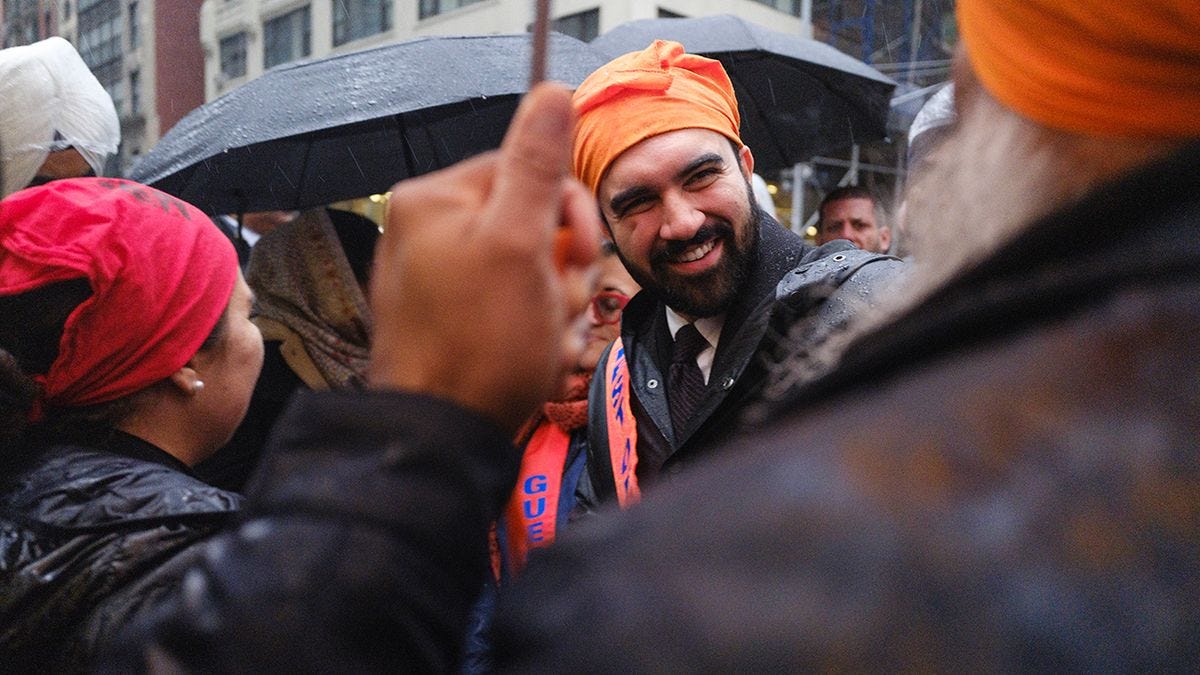
Mamdani’s support for the Sikh community moved many Sikhs, leading to large mobilizations in support of his campaign. He maintained early expectations, although in a light-hearted way, when his swearing-in ceremony featured a performance by Babbulicious.
Karamvir Kaur, a community organizer and artist living in New York, largely stayed out of politics and remained skeptical of politicians throughout her life. She recalls that when Mamdani began campaigning, she thought his message was nice but doubted whether it would become reality.
“But I have to say, I’ve been pretty impressed by the things that he’s been able to do within just a few months of being in office,” she said.
However, as a diverse community, Sikhs still have different opinions and expectations about Mamdani’s broader policies, messages, and progress. After eight months in office, many are conflicted about whether Mamdani can deliver on his broad goals of universal preschool education, free and faster buses, and affordability. Some also fear he will fail to keep his promises to make Sikhs feel safe, included, and represented in a city where they have experienced numerous instances of hate and violence.
The First Impressions
Gunita Singh, an attorney for the Reporters Committee for Freedom of the Press, says Mamdani has been a strong mayor and has made progress on universal pre-kindergarten education and housing affordability.
“[For] millennials like myself and my fiancé, who have dreams to maybe own property and want to enjoy a decent quality of life in the most expensive city in the country,” Gunita said, “Mamdani’s style of governance really speaks to us because it places a high value on compassion and empathy alongside public safety and law and order.”
Another concern for many New York City Sikhs has been tenant protections and rent freezes, which Mamdani has advanced, according to Amritpal Singh, a trustee of Baba Makhan Shah Lubana Sikh Center.
Mamdani has also supported Sikhs by working to make the Sikh Day Parade a bigger event and to institute Sikhs within his political administration, according to Amritpal. The Sikh Day parade is an annual event in Manhattan that began in 1988 to celebrate Vaisakhi and Sikh culture through colourful floats, performances, and free food.
“Him coming to the Sikh Day parade means a lot for Sikhs…a lot of people feel really good that they have the Mayor on their side and that the Mayor will protect them from hate crimes. Immigrants feel really safe, especially Sikhs,” Amritpal Singh said.
Pavita Singh, a Columbia University graduate based in Manhattan whose research focused on young American Sikh women, notes that some of Mamdani’s goals for the city include free buses and free childcare, which are great ideas in theory but need careful rollout.
“Right now the situation is that there’s such a disparity in what child care is affordable versus not affordable; your kid might not be getting access to the best possible services,” Singh said.
“So, I think it’s ambitious, and these are great ideas, but I think they need to be rolled out with a lot of caution to make sure that we’re not perpetuating disparity or inequity in the pursuit of trying to erase it.”
The Relations with Gurdwaras
South Richmond Hill is home to one of New York City's largest Sikh diaspora communities, with the Gurdwaras among the first on the East Coast.
One issue Mamdani consistently stressed during his campaign and after his win was his support for New York City's Sikh community, especially in South Richmond Hill. Mamdani demonstrated this through visiting the Baba Makhan Shah Lubana Sikh Center (BMSLSC), in South Richmond Hill, as the first and last stop of his campaign trail.
Vachitar Singh Judge is a public relations manager of Baba Makhan Shah Lubana Sikh Center. Judge said the gurdwara was proud that Mamdani chose to visit as his first and last stop and that certain issues, such as collaboration between the Gurdwara and the New York Police Department (NYPD) to increase security, have improved.
Judge highlights that despite improvements, the Gurdwara still has a list of priorities it wants Mamdani to address, ranging from funding for security guards to a funeral center, a community center, and a public school.
“We have a list of things that we want the mayor to get done. We always have meetings with them or kind of relate the message to [them] through their public relations in charge,” Judge said.
Despite the praise for his visits, political figures visiting gurdwaras in New York City isn't unique to Mamdani, as Baba Makhan Shah Lubana Sikh Center has hosted other notable visitors, including former New York governor Andrew Cuomo.
Saihaj Gulati, a creative writer and security engineer who recently moved from California to New York, feels that politicians’ gurdware visits have felt fake in the past, but Mamdani’s feel more authentic because he supports Sikh culture in more ways than just through gurdwara visits.
“What helps him [Mamdani] is that he’s going to gurdware, but then also doing these other things like talking about the culture, talking about us [Sikhs], platforming our [Sikh] artists, so it’s a little bit more like maybe you actually do care for us and so then it all fits together and feels less fake,” Gulati said.
Monica Gill, a prominent actor in Indian and Punjabi Cinema, who has starred in several movies, agreed that Mamdani’s visits to gurudware feel genuine.
“I think there’s a difference between just going to a gurdwara as a pit stop, to mark or check something off a box versus being like ‘hey, you’re part of the community here and I want to be your representative’ and actually going and understanding what it’s about and I think Mamdani did that,” Gill said.
The Fight Against Transnational Repression
Sikhs have been facing transnational repression for decades, as the Indian government has attempted to silence Sikhs in the U.S. who advocate for Sikh rights in India.
In June of 2023, American law enforcement intervened in an attempted assassination plot against Sikh activist Gurpatwant Singh Pannun. Nikhil Gupta, an Indian national, admitted to being hired to kill Pannun, and the FBI charged Indian spy Vikas Yadav for the plot.
Mamdani has been known for getting involved in international issues by criticizing Hindu Nationalist Indian Prime Minister Narendra Modi for his various human rights abuses and taking a stand against Israel.
Now, a concern for Sikhs in the city is whether or not Mamdani will be able to provide them with a sense of security in increasingly uncertain times where Sikhs are continually targeted, oppressed, and silenced.
Karamvir said she appreciates that Mamdani does not shy away from international issues, but she is not necessarily asking him to do it, as he has other priorities to focus on.
Gill said she does not see Mamdani’s criticisms having much effect, since although speaking out against bigotry is important, little change can happen unless someone is actively pushing Modi out of office.
Some take a different approach, as Gulati feels that Mamdani’s outspokenness has helped him build a voter base that feels supported, when, in the past, most felt that politicians do not care and cannot identify with the common man.
“Which I think plays into the whole thing that he’s on the ground, he’s one of us, and it’s that feeling that we all seemed to really vibe with,” Gulati said.
Pavita agrees that Mamdani’s involvement in international affairs, especially his criticism of Modi, is beneficial and even reflects certain Sikh values.
“I know that it comes at the risk of alienating a lot of people and potentially putting Sikhs at risk. But think about what our Gurus did, right?” Pavita said. “They took the unpopular opinions, and they fought for what they believed was right because it’s in the best interest of all the people.”
Amritpal also agreed and stressed that Mamdani’s stand against Modi’s human rights violations shows the Sikh community that he is aware of Sikh history.
“Other mayors don’t talk about Modi much, but Mamdani talks about it,” Amritpal Singh said. “It shows Sikhs that this guy actually cares about us.”
The Sikhs in the Office of the Mayor
Mamdani has given Sikhs space in his administration by appointing Jagpreet Singh as first deputy commissioner, office of mass engagement, and Manvir Singh as senior policy analyst.
Mamdani’s win has been extremely refreshing for the city, especially because of his openness and authenticity in showing his humanity, as well as his welcoming, inclusive approach toward the Sikh community, according to Pavita.
“The fact that he’ll share things about how he met his wife, or his experiences growing up as a two-culture child–I think that’s really beautiful,” Pavita said. “I’ve seen that he’s encouraged a lot of young people to get involved in politics.”
Gill believes Mamdani’s representation matters because he represents not just his own community, but all minority communities in New York.
“I think he genuinely has made an effort to connect with the community…he had a lot of Sikh young individuals within his campaign, he understands what the community is looking for, he wants to be a good representative for us,” Gill said. “And I’m also speculative about what he can get done and what he can’t.”
Mamdani is strongly supported by Gen Z, as 75 percent of youth voted for Mamdani according to exit polls conducted by the Tufts Center for Information and Research on Civic Learning and Engagement.
Gulati said Mamdani has given Gen Z Sikhs hope by making them feel someone actually cares about them and the issues they worry about, such as rent control and affordability.
“In terms of platforms and initiatives, there honestly hasn’t been a huge amount of change other than just this feeling that since our mayor is Muslim and talks about all these cultures, maybe we can be a little bit more inclusive with each other,” Gulati said.
Although Mamdani’s win holds significant cultural weight, Karamvir cautioned that Sikhs should know their priorities so they can hold Mamdani accountable for addressing their issues.
“There’s a priority list that exists within [Mamdani’s] office that I don’t understand; there’s been plenty of times I’ve been disappointed, but I’ve also been able to hold that with all the good things that are happening in New York so far,” Karamvir said.
Only eight months into his term, the future will prove if he can deliver on his promises of reform, representation, and hope.
Bani Chauhan is a student at the University of Southern California in Los Angeles, studying International Relations.
Baaz is home to opinions, ideas, and original reporting for the Sikh and Punjabi diaspora. Support us by subscribing. Find us on Twitter, Instagram, Facebook, and TikTok at @BaazNewsOrg. If you would like to submit a written piece for consideration, please email us at editor@baaznews.org.