

Jaskaran Sandhu
August 28, 2026 | 5 min. read | Analysis
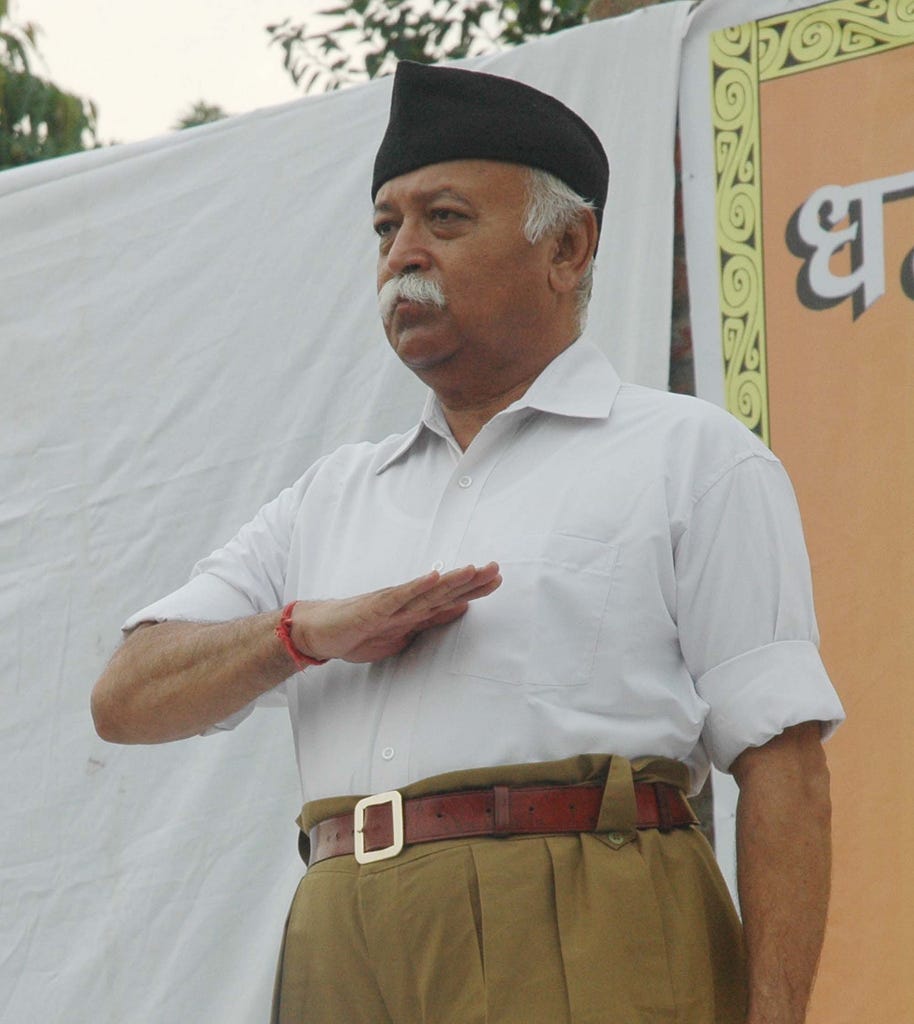
When Mohan Bhagwat, the chief of the Hindu Nationalist Rashtriya Swayamsevak Sangh (RSS), lands in Toronto from his visit to America at the end of August, he will do so as the head of an organization that the United States Commission on International Religious Freedom (USCIRF) has recommended for targeted sanctions over “severe violations of religious freedom.”
“We urge the U.S. government to consider targeted sanctions against RSS members and Indian officials complicit in religious freedom violations, including revoking the visa issued to Mohan Bhagwat and making him ineligible for future entry into the United States,” USCIRF Chair Asif Mamooh stated in a recent press release.
The RSS is the ideological parent of the Sangh Parivar. Canada’s own Immigration and Refugee Board identifies the ruling Bharatiya Janata Party (BJP) and the overseas Hindu Swayamsevak Sangh as constituent members of that network.
CSIS, in its 2024 Public Report, describes Narendra Modi’s BJP government as implementing a Hindu Nationalist agenda. The Foreign Interference Commission found that the Indian government engages in transnational repression on Canadian soil. The RCMP has stated it obtained evidence linking Indian government agents to homicides, extortion, and coercion within Canada.
These facts alone should settle the admissibility question in Canada. It hasn’t, and the Carney government’s silence is noticeable and can only be read in the context of his administration’s efforts to renew ties with India, even as Sikh activists continue to receive “duty to warn” letters from Canadian police authorities.
Admitting its supreme leader for a tour, which the organizers themselves have described as an effort to reshape international perceptions of the RSS, asks Canada to lend its soil to an image-washing exercise. On the standards Canada applies to extremist organizations across the ideological spectrum, the answer should be no.
This is what the coalition assembled by Justice For All Canada, spanning Muslim, Sikh, Jewish, Dalit and civil society organizations, argues in its open letter to Ottawa.
Against the Justice For All letter stands a rival document from a group calling itself CHORD, Canadian Hindus for Outreach, Relations and Dialogue, claiming the backing of “more than 500 Canadian organizations and civil liberties groups.”
The letter only lists 101 organizations, however, then tacks on “and many more.” A genuine coalition of 500 would proudly name all 500. And, to make matters worse, even the 101 it does list do not stand up to scrutiny.
Several are the same organization counted twice.
For example, the Canada India Global Forum appears as both entry 17 and entry 24, once by name and once by its acronym. The Hindu Sikh Unity Forum appears at 48 and 49. The Indian Family Association appears at 57 and 58. The South Shore Indian Association appears at 87 and 88.
Others are untraceable as institutions in any meaningful sense, with no discernible governance, membership, or public presence beyond their appearance on this list.
Then there is the framing in which CHORD describes its signatories as “civil liberties groups,” designed to travel well within a Canadian pluralist idiom. However, most are clearly nothing of the sort. The roster is essentially a directory of Hindu temples and regional caste and language associations.
What remains at the core of the CHORD list is not a neutral cross-section of Hindu Canadians. It is the organized Canadian infrastructure of the very Hindu Nationalist movement that Bhagwat leads.
The Hindu Swayamsevak Sangh, a signatory, is the RSS’s own overseas wing. VHP Canada, a signatory, was the first RSS-linked organization established in Canada and operates as a branch of the VHP, which was found by Human Rights Watch to be one of the bodies most responsible for the 2002 anti-Muslim pogrom in the state of Gujarat. Sewa International, a signatory, is the RSS’s charitable arm.
In other words, RSS affiliates, allies and subsidiaries have signed a letter demanding that Canada admit the RSS chief, presented as the spontaneous and broad voice of community and “civil liberty” groups.
Around that core sit the movement’s Canadian political allies.
The Canada India Foundation, which Baaz has previously documented co-hosting events alongside HSS-linked groups, is a signatory.
The Canada India Global Forum (CIGF), whose president has been visited by CSIS over his links to the Indian government, is a signatory.
The Hindu Canadian Foundation, a self-styled advocacy body that congratulates Modi on election wins and reflexively brands critics as “Khalistani,” is a signatory.
Canada Hindu Vote and the Canadian Hindu Chamber of Commerce, both of which The Breach has tied to a growing alliance between the Hindu right and Canada’s Conservative Party, are also signatories.
Even some of the ostensibly apolitical Canadian temples are not always what they appear. The Sanatan Mandir Cultural Centre in Markham, a signatory, hosted a video address from Modi himself.
The CHORD letter then fed into a media and propaganda circuit that starts in the Indian press and returns to Canada with the authority of fact-checked news.
It began, predictably, in the RSS’s own house journal. Organiser ran the letter as proof that “more than 100 Canadian organisations and civil liberties groups” back the visit, reporting that they had urged Ottawa “to ensure his entry decision is based on evidence, due process and equality.”
From there it entered the mainstream as straight news through wire agencies like IANS, reproduced verbatim by small and relatively unknown online outlets such as Prokerala and India New England.
Major Indian outlets followed. NDTV told a national Indian audience that “more than 100 Canadian organisations and civil liberties groups” support Bhagwat’s visit and urged Canada to “reject calls for blocking” him, while Hindustan Times framed it as Indian Canadian groups opposing those critical of the RSS.
Then the framing hardens with the likes of WION airing a segment warning a ban could be seen as prejudice against Hindus. An ANI opinion piece declared “more than a million Canadian Hindus” were “excited to welcome” him and called the opposition “baseless.”
By the time the story reached OpIndia, the hundred-odd signatories had become a coalition that “debunks propaganda,” while the two elected Canadian MPs publicly opposing the visit were relabelled “Pro-Khalistani” and lumped in with unnamed “Islamist and separatist outfits.”
The CHORD letter wants Canadians to see this debate as a religious minority asking only to welcome its own spiritual leader, against a handful of politically motivated and baseless naysayers.
It is a compelling frame. It is also false in almost every way.
The real request is that Canada disregard the findings of its own intelligence service, foreign interference inquiry, and federal police, based on a signatory list that cannot count straight.
Jaskaran Sandhu is the co-founder of Baaz. He is a lawyer and previously served as Executive Director for the World Sikh Organization of Canada and as a Senior Advisor to Brampton’s Office of the Mayor. You can find Jaskaran on Twitter at @JaskaranSandhu_
Baaz is home to opinions, ideas, and original reporting for the Sikh and Punjabi diaspora. Support us by subscribing. Find us on Twitter, Instagram, Facebook, and TikTok at @BaazNewsOrg. If you would like to submit a written piece for consideration, please email us at editor@baaznews.org.
Worst offenders are those dressed up like Sikhs but doing everything to hurt the community’s hard earned reputation : most of the fake ‘Khalistanis’ and these Indian agency bankrolled thugs . with their antics times perfectly to political events in India ... we also need to increase our outreach , monitor social media jate campaigns , tap into far right networks to see what hate and disinformation is being spread by these vile Hindutva types who will only end up hurting all overseas Indians badly