


Jaskaran Sandhu
December 29, 2025 | 3 min. read | Opinion
If there is one through line that defines 2025 for Sikhs globally, it is that Anti-Sikh hate has become normalized, coordinated, and algorithmically amplified.
This did not happen in a vacuum.
Across the West, far-right nationalist and white supremacist movements have gained renewed confidence and visibility, aided in part by social media platforms that increasingly reward outrage, racial grievance, and conspiratorial thinking. Since Elon Musk’s takeover of Twitter, changes to content moderation and engagement algorithms have helped create an environment where hate no longer merely survives online. It thrives.
Sikhs, as a visibly distinct, economically successful, and politically engaged minority, have increasingly found themselves in the crosshairs of these movements. Turbans, beards, Gurdwaras, and public religious processions mark Sikhs as outsiders in societies where xenophobia is gaining steam. But what makes the current moment uniquely dangerous is not simply the rise of Western far-right hate. It is the way that Hindu Nationalist networks, mainly operating out of India, have actively fused themselves to these movements to target Sikhs in the diaspora.
This alliance is cynical and opportunistic.
Hindu Nationalists understand perfectly well that Western white supremacists also harbour and advance deep hostility toward Hindus and Indian immigrant communities more broadly. That contradiction does not matter. As long as Sikhs are the immediate target, Hindu Nationalist actors are willing to amplify, excuse, and launder hate from any source. Moral consistency is irrelevant. Tactical utility is everything.
We are often told, disingenuously, by Hindu and Indian Nationalists, that they do not hate Sikhs, only those labelled Khalistanis (not that there is anything wrong in believing in Sikh sovereignty and self-determination, but we can put that conversation aside for now).
That claim, however, collapses under even minimal scrutiny.
In practice, any Sikh who is politically active, outspoken, or simply visible can be arbitrarily branded a Khalistani “extremist”. Advocacy for Sikh rights, remembrance of state violence, or criticism of Indian government policy is enough to trigger waves of disinformation and abuse. The goal is not to debate ideas. It is to delegitimize and cast a shadow on an entire community.
The incident in New Zealand earlier this month illustrates this dynamic with clarity.
When members connected to Brian Tamaki’s Destiny Church, an organization frequently described by observers as cult-like and known for a pattern of inflammatory actions, like once holding a demonstration to tear apart a Hindu flag, blocked a Nagar Kirtan procession, the hostility was unmistakable. Protesters shouted “Jesus is King” and told Sikh participants to go back to India. This was a religious hate incident, plain and simple, directed at a peaceful Sikh religious procession organized by local Gurdwaras and attended by families, elders, and children.
Yet almost immediately, pro-Hindu Nationalist accounts moved to reframe the incident. They falsely claimed the demonstration was aimed at Khalistanis and suggested that Sikhs had somehow provoked or deserved the abuse. They amplified footage not to condemn the hate, but to justify it, boosting the reach of a group that despises them as much as it despises Sikhs. Go back and watch the video of the incident. There are no Khalistan flags in sight, and even if there were, how does that justify what happened?

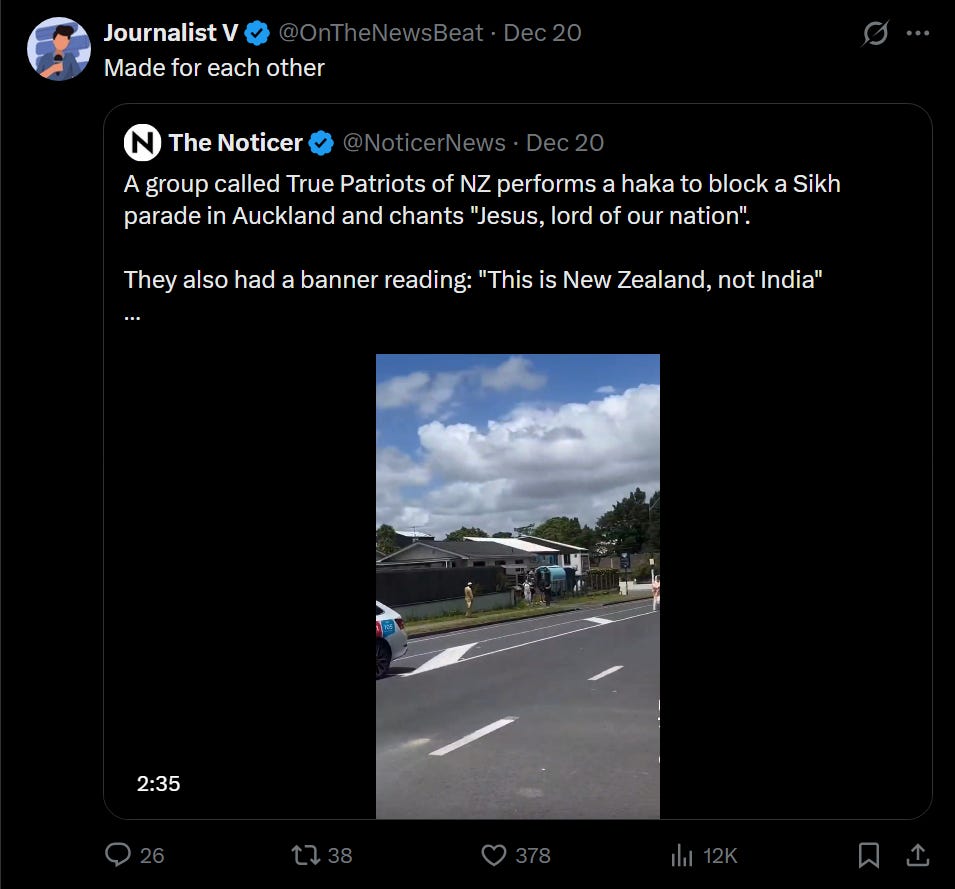
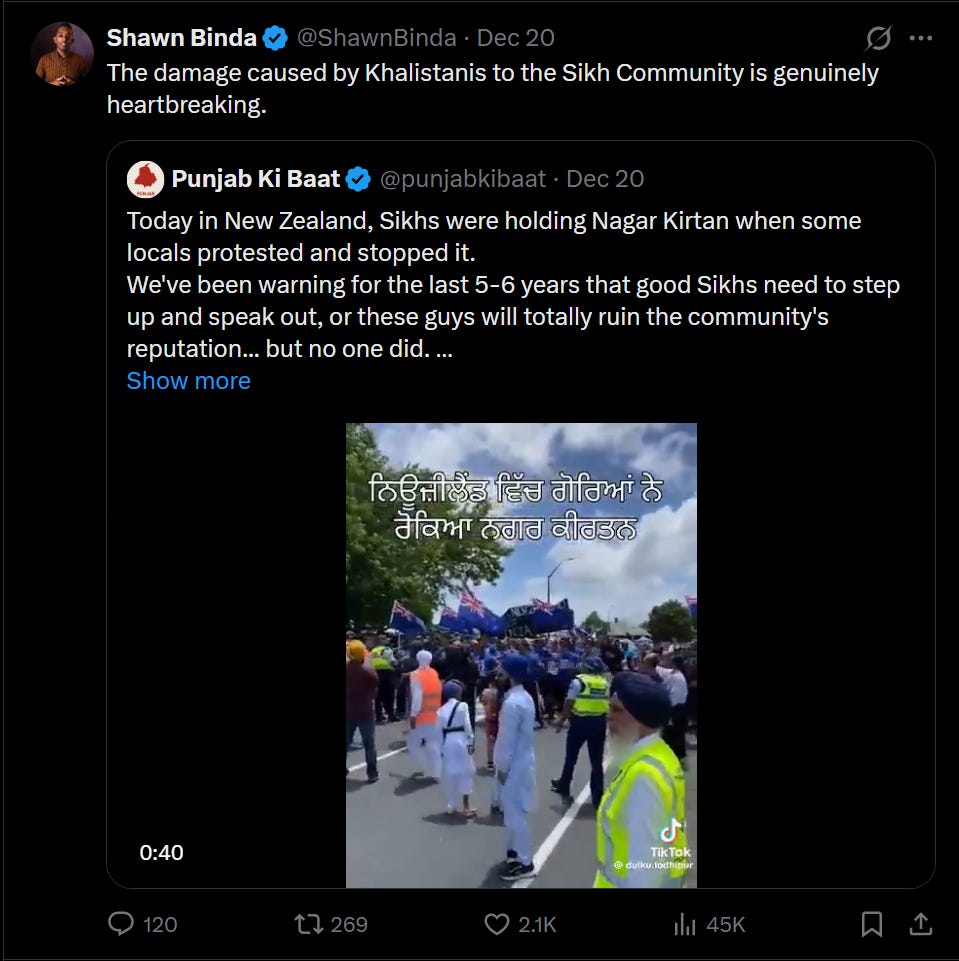
This is how modern Anti-Sikh hate operates. It is produced at the intersection of far-right nationalism, white supremacy, and Hindu Nationalism, then scaled through coordinated online networks that exploit platform algorithms. IT cells, bot farms, and engagement manipulation turn localized incidents into global spectacles, stripped of context and repackaged as propaganda. The result is a feedback loop in which Sikhs are constantly portrayed as threats, extremists, or outsiders, regardless of the facts.
The consequences are no longer abstract. In the United States, Sikhs are now the third most targeted religious group for hate crimes, after Jewish and Muslim communities, according to FBI data. In Canada, Anti-Sikh hate has risen sharply as well, occurring alongside India’s involvement in transnational repression and state-sponsored terrorism. And, as we just witnessed in New Zealand, our ability to practice our faith freely is in question.
What the Nagar Kirtan incident shows us is not merely that Sikhs are being targeted. It shows us how that targeting is rationalized, excused, and accelerated, often by those who claim to be allies, and almost always by those who see Sikh identity as expendable in a larger ideological battle.
Anti-Sikh hate was the story of 2025. And unless governments, decision makers, and civil society begin treating it as the grave and coordinated threat that it is, there is little reason to believe 2026 will be any different.
Jaskaran Sandhu is the co-founder of Baaz. He is a lawyer and previously served as Executive Director for the World Sikh Organization of Canada and as a Senior Advisor to Brampton’s Office of the Mayor. You can find Jaskaran on Twitter at @JaskaranSandhu_
Baaz is home to opinions, ideas, and original reporting for the Sikh and Punjabi diaspora. Support us by subscribing. Find us on Twitter, Instagram, Facebook, and TikTok at @BaazNewsOrg. If you would like to submit a written piece for consideration, please email us at editor@baaznews.org.