

Jaskaran Sandhu
July 14, 2026 | 6 min. read | Analysis
Satluj may ultimately matter more as a political event than as a political film.
Yes, it introduces a mass audience to Shaheed Bhai Jaswant Singh Khalra and to the thousands abducted, killed and secretly cremated during the Indian state’s campaign of repression in Punjab. But as a portrait of Khalra himself, and what moved him, it is wrongfully cautious and politically evasive.
It tells us what he discovered, but too little about the man who had the clarity and courage to pursue it.
The Film
Khalra did not suddenly become politically conscious after encountering crematorium records.
His formation included student activism before his politics evolved toward a clear position centred on Sikh sovereignty. In his own writing for Liberation Khalistan, the publication he founded and edited, and in his speeches, he supported the Khalistan movement and spoke openly of Sikh nationhood and the right of Sikhs to determine their own future.
His ideology was not hard to place. It was clear, and it was Sikh. That clarity is what the film and its defenders launder out rather than celebrate, because a Khalra with a defined Sikh moral compass is harder to absorb by Indians than one who simply stumbled into activism.
There is a fair counter to this critique. A film cannot offer a complete political biography, and the filmmakers chose the final fourteen months of Khalra’s life. But stripped of his political formation, the film’s Khalra can seem to encounter state violence almost by accident.
The same narrowing shapes the violence Khalra uncovered in the movie.
Satluj shows terrifying officers, but the violence too often appears as the work of a rogue section of the Punjab Police rather than a national system which encouraged and fostered such behaviour, with the central government out of view.
Yet the crimes were not isolated excesses or the actions of a few bad actors. Human Rights Watch and Ensaaf documented how special laws and cash rewards for police who captured or killed those the state branded “militants” drove enforced disappearances and killings. Without that framework, the history collapses into “Sikh on Sikh violence,” and the Indian state disappears from a story about people it disappeared within a larger genocide emerging out of the 70s and 80s.
For example, the film’s treatment of the Central Bureau of Investigation is revealing.
The CBI investigated Khalra’s abduction, and some officers were eventually convicted for his murder well after the fact, but Satluj presents this as proof the system corrected itself. It did not. The convictions never reached command responsibility, the central government continued to act with impunity, and despite eyewitness testimony implicating then police chief KPS Gill in Khalra’s detention and killing, no charges were brought against him.
The charge that the film demonizes police is also hard to sustain when it distinguishes murderous officers from honest ones and offers the CBI as correction. Yet even this restrained account has been condemned as propaganda. The objection, in reality, is not that the film is unfair to police or that it is a national security risk; it is that it asks the audience to centre those the state disappeared.
The Number
The debate about the movie also retreats repeatedly into a dispute over numbers.
Was 25,000 an established count or an extrapolation? Speaking on the Newslaundry podcast Hafta, Hartosh Singh Bal challenged the film’s figure, putting the number closer to 7,000 on the basis of crematoria data and police-action timelines, and framed the film as propaganda.
These are legitimate questions, and numbers matter, above all to families seeking the fate of their loved ones. But there is no settled state-wide count because the man assembling one was killed before he could finish it. In his best-known speech Khalra cited 6,017 bodies documented in the municipal records of the Amritsar district alone, a count drawn from records rather than a slogan. He was mid-investigation, and the state disappeared him while that work was underway.
The ambiguity that now hangs over the numbers is not a neutral gap in the record. It is the intended result of his murder. To demand methodological certainty from Khalra’s figures is to demand that he complete an inquiry the state killed him to prevent. The confusion is used to discredit the very people pointing at the graves, when it was manufactured by those who dug them.
Whether the true figure is 7,000, 25,000, or higher, the crisis was never the exact total but that agents of the state could indiscriminately abduct people, kill them, dispose of their bodies and deny families any remedy. A debate about scale must not be used to deny the system itself.
The 7,000 figure also warrants caution because it comes from a commentator who is not neutral about this history and continues to be given a platform to whitewash what happened. Hartosh Singh Bal is the maternal nephew of K.P.S. Gill, and in 2017 wrote a defence of his uncle arguing that Gill could not be singled out, that torture was a widespread practice and that this was the price of “peace”. Khalra, whose investigation implicated Gill directly and who had named him the “Chief of Oppression,” is the counterweight to that defence. A lower number offered by Gill’s own nephew cannot be received as disinterested arithmetic.
The Reaction
The film continues to be banned by the central government.
Known initially as Panjab ’95, it stalled for roughly three years after India’s censor board demanded more than 120 drastic changes. It finally reached ZEE5 on July 3, 2026, as Satluj, and was pulled in India two days later after officials reportedly ordered its removal on national security grounds.
A film about disappearance was itself disappeared.
The removal demonstrated the principle that shaped Punjab in Khalra’s time. Sikh memory and expression are tolerated only within the parameters set by the central Indian state. Even a sanitized and watered-down version of it.
The state may permit sorrow; it is far less willing to permit analysis. It can partially accept Khalra as a humanitarian symbol three decades after his murder; it cannot accept him as a political Sikh who linked the disappearances to the legitimacy of state power.
The response across Punjab supplied another missing part of the story.
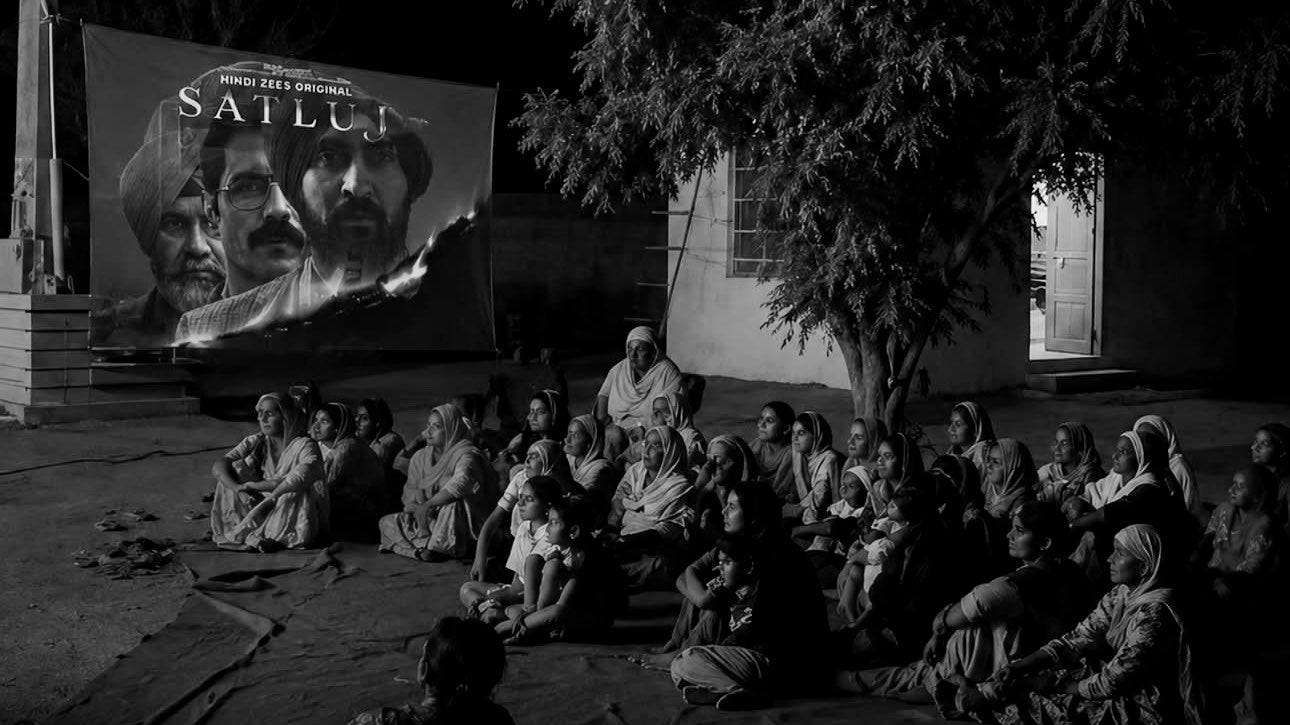
After Satluj vanished from streaming, Sikh organizations, activists and residents began screening it in gurdwaras, village halls and community spaces, elders who lived through the state’s campaign of repression watching beside teenagers born long after it ended.
For decades these memories were treated as dangerous or illegitimate, and families were expected to mourn quietly in the vocabulary of national security. The screenings reject those conditions, just as Khalra would have wished for.
Gurdwaras and village grounds have become public archives, and younger Sikhs are encountering a history within a communal setting that has otherwise been kept out of government-controlled classrooms and authorized national memory. The removal galvanized precisely the audience it was meant to silence. The state treated Khalra’s memory as a security problem; the Panth treated it as an inheritance.
The reaction from parts of India’s liberal voices and media has been equally revealing.
Many of these commentators condemn abuses tied to the BJP and Hindu Nationalism while rationalizing violence carried out by earlier Congress governments or central institutions imagined to be secular and necessary.
This is why Gill remains central to the national story. Once he is fixed as the “super cop” who saved Punjab, the disappearances, torture and secret cremations become secondary, excused by the claim that peace was restored. During one NDTV discussion prompted by the film, journalist Tavleen Singh called Gill a hero. He receives centralized credit and decentralized blame. The peace belongs to Gill; the bodies belong to no one.
Khalra himself is subjected to the same test.
He supported Khalistan and said so plainly, and that admission is used to decide whether he deserves to be believed, creating an impossible standard in which Sikh victims must first prove ideological respectability within an Indian moral universe they have no say in before their abduction can be condemned. The state is not required to establish innocence before it is defended; the victim is required to establish loyalty before being mourned.
This leads to one point on which the liberal commentators and the film’s Sikh critics agree.
Satluj was wrong to erase Khalra’s beliefs about Khalistan. However, the two camps want it for opposite reasons. Sikhs want it included because it supplies the context, the political conviction that drove him to confront this injustice in the first place. The Indian liberal commentators want it surfaced so it can be wielded as justification, the proof that he was the kind of Sikh whom the state could abduct, torture and kill with immunity.
This is precisely why the filmmakers’ omission was a mistake. By hiding his politics rather than stating them plainly, they let his convictions become something furtive and sinister dragged into the light by his detractors, rather than setting the narrative from the outset that Khalra saw Sikh sovereignty as a noble cause, especially in the face of Indian atrocities.
In the end, India cannot tolerate the full implication of Khalra’s life. That he was a Sikh political actor who understood the disappearances as an expression of central state power in Punjab.
That is what Satluj also mistakenly avoids and what the reaction to it restores. This is why the reaction tells us more about Khalra than the film does.
The film shows a courageous man following evidence; the censorship shows the state he confronted.
The film shows abusive officers; the defence of KPS Gill shows the establishment that still justifies them.
The film shows Khalra’s investigation; the community screenings show the people for whom it remains unfinished.
Satluj deserves to be watched and defended, and also challenged for offering a Khalra safer than the man himself. His revolutionary spirit came from his refusal to accept the state’s power to decide whose life counted, whose death could be hidden and whose memory could be erased.
The film tells us that Khalra uncovered the disappeared. The reaction tells us why the state still fears their return to public memory.
Jaskaran Sandhu is the co-founder of Baaz. He is a lawyer and previously served as Executive Director for the World Sikh Organization of Canada and as a Senior Advisor to Brampton’s Office of the Mayor. You can find Jaskaran on Twitter at @JaskaranSandhu_
Baaz is home to opinions, ideas, and original reporting for the Sikh and Punjabi diaspora. Support us by subscribing. Find us on Twitter, Instagram, Facebook, and TikTok at @BaazNewsOrg. If you would like to submit a written piece for consideration, please email us at editor@baaznews.org.
Well argued