

Akanksha Dhingra
November 27, 2025 | 5 min. read | Original Reporting
It’s a damp Saturday night in Vancouver, and eight-year-old Simran Singh is sitting in the stands at Rogers Arena with his parents. On the ice, Arshdeep Bains, a Punjabi Sikh professional ice hockey player with the Vancouver Canucks, skates fast towards the net, his stick low. With a quick snap, the puck hits the back of the goal and the crowd roars.
Arjun’s dad leans down to him and says quietly, “One of us made it.”
For Simran, it’s the first time he’s seen someone who looks like him, with a name like his, in the National Hockey League (NHL). That moment plants a seed: maybe professional sports is for him, too.
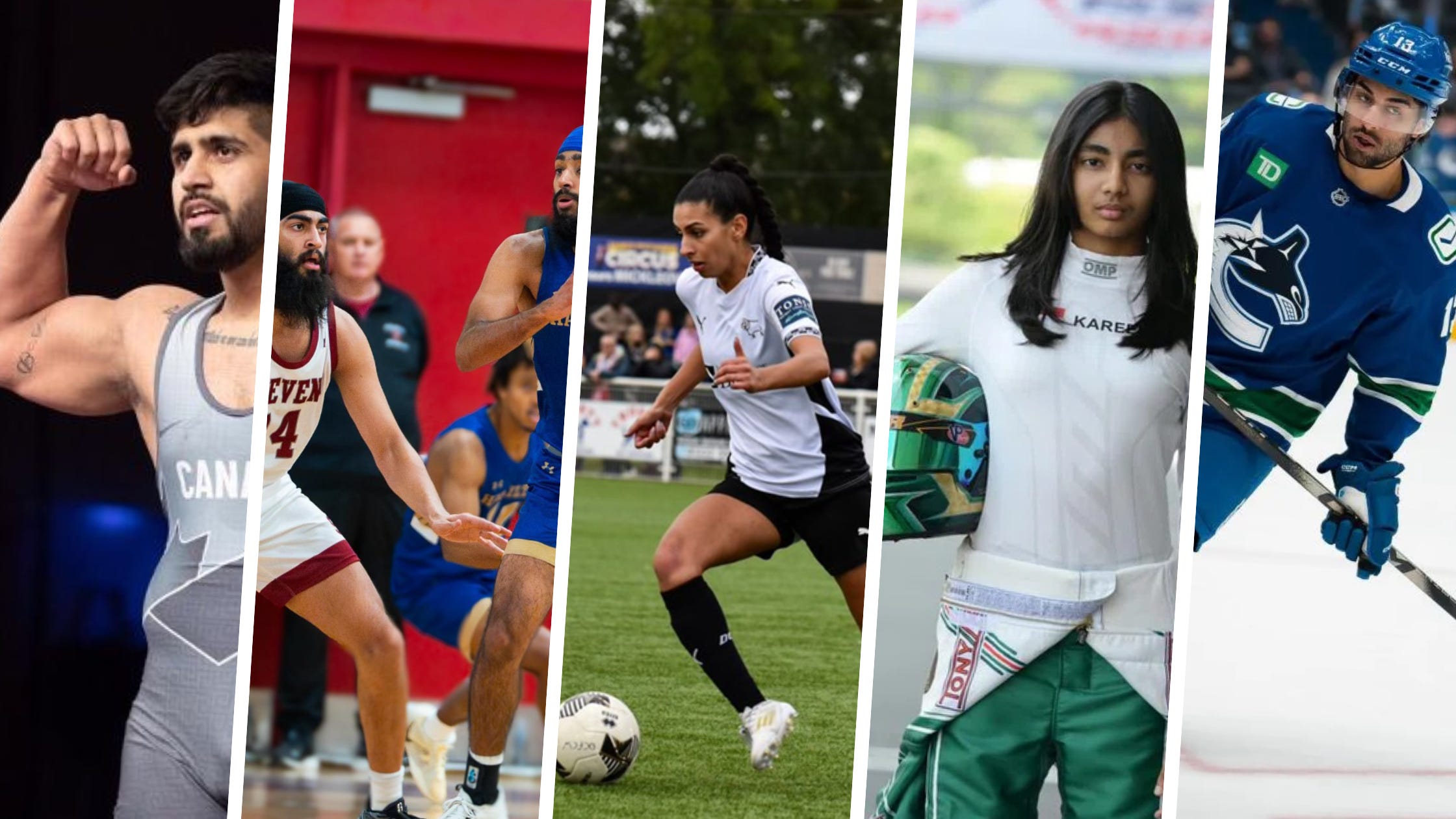
Diasporic Sikhs are finding success across an expanding range of sports, far beyond the more traditional athletic pursuits in South Asia, such as cricket and field hockey.
The examples are starting to grow.
At the 2022 Commonwealth Games in Birmingham, the men’s freestyle 125 kg wrestling event produced a remarkable moment when all three medalists had Punjabi roots, each competing under a different flag.
The “India-heritage” roster at the Amerigol Latam Cup, an ice hockey tournament for non-traditional markets, was so dominated by Punjabis and Sikhs that fans on social media began referring to it as Team Punjab.
When reports surfaced that India was considering allowing Overseas Citizens of India (OCIs) to represent the national football team, much of the online discussion focused on Punjabi footballers from the diaspora already being tracked by scouts.
Sikh athletes have played basketball at the NCAA level for years, and India Rising, the team that captured attention during its unlikely run in The Basketball Tournament 2023, was primarily composed of Punjabi players.
Sareet Kaur recently became the first Sikh to captain England’s U16 squad, while on the other side of the world, Sarpreet Singh is preparing to represent New Zealand at the next World Cup.
Randeep Singh currently serves as a Head of Race Strategy in Formula 1, and Kareen Kaur has broken new ground as the first Sikh woman to compete in Formula 4.
The list goes on, and while there has been a noticeable, much-celebrated increase in Punjabi youth succeeding in amateur and professional sports, with more prospects destined to reach the big leagues, it was not always that way.
Punjabi families began settling across the diaspora well over 100 years ago, carving communities where kabaddi on Gurdwara grounds kept athletic roots alive.
Yet, organized sports remained a dream for many kids who remained out of touch with elite development programs, professional scouts, and coaching. Even today, that dream comes with a price tag. A recent RBC survey shows Canadian families spend an average of C$4,478 per year on organized hockey, for example. That’s about C$53,700 by the time a child turns 16.
Racism and bias have been, and remain, other real barriers in community sports. In 2023, 26 per cent of athletes and volunteers in Canada said racism and discrimination were a problem in their sports circles, while 18 per cent reported witnessing or experiencing unfair treatment over the past five years, which later climbed to 12 per cent among racialized participants. Of the respondents from the same study, 22 per cent said they were threatened or harassed, and 14 per cent said they had been physically attacked or assaulted.
These numbers matter when small biases decide who gets to play, or who’s invited for tryouts, who gets cut, or who is seen as “not a fit.”
Dr. Courtney Szto, Assistant Professor in the School of Kinesiology and Health Studies at Queens University in Kingston, Ontario, elaborates on how South Asian players in hockey and sports have often been always visible, yet invisible. They are seen for their difference yet overlooked when it comes to opportunities.
That pattern shows up again and again in research about Punjabi players in Canadian ice hockey; community interviews and fieldwork underline how everyday bias, not always obvious abuse, can cost a player their chance to play the sport.
Across the Atlantic, Kira Kaur Rai, a soccer player based in England, who has been a part of the women’s team at Derby County Football Club, has personally experienced both historic successes and headline-making battles against racism in competitive sports. As with hockey in Canada, football in the UK is also seeing more Punjabi talent in the professional pipeline.
“For Punjabi and Sikh athletes, the pathway can feel harder to navigate because you don’t see people who look like you in leadership, coaching, or media roles,” Rai said, adding that the “lack of visibility can affect confidence, but it also motivates you to break through as it has done to me personally.”
Rai highlights that one of the toughest barriers is visibility.
“On the field, you want to be judged purely on ability, but sometimes there’s an unconscious bias that creeps in, questions about whether you ‘fit the mould’ of what people expect an athlete to look like or play like,” she said.
Off the field, Punjabis have also seen success in sports broadcasting.
Amrit Gill is a Canadian TV host and producer who often covers sports and is part of the popular national TV program “Hockey Night in Canada Punjabi”. She said that growing up in immigrant households where sports are not always considered a realistic career path can sometimes mean opportunities at elite levels become limited.
“I know the feeling personally. Growing up, I didn’t always see myself reflected in the world of sport or media, and I often felt I had to prove twice that I belonged,” Gill said.
As diasporic Punjabi and Sikh athletes are making history in sports like hockey, cricket, wrestling, MMA and more, their stories are often missing from the national sports pages and TV coverage.
Gill said she experienced being tokenized by parts of the sports media industry that lacked a nuanced lens, seeing her only as a voice of diversity rather than recognizing the full depth of what she brings.
“That kind of pigeonholing is something I see mirrored in how athletes are often framed, reduced to identity instead of celebrated for their full humanity,” Gill said, echoing findings from Dr. Courtney Szto.
“Diversity of thought and lived experience in production rooms is crucial. If the people deciding what gets covered don’t reflect or understand the communities of the athletes themselves, important narratives can be overlooked,” she adds.
Regardless, Punjabi and Sikh athletes have drawn on their own history of competition, triumph, and athletic excellence to drive their success.
Karenjeet Kaur Bains, born in Warwickshire, was the first Sikh woman to compete for Britain in 2019. “I’m very proud of my culture and my heritage,” Bains told Malala at the time. “I insist on having my full name...I also wear a kara…I have rituals in my head when I’m on the platform, and I’m lifting. It helps keep me focused if I think of God,” she said.
Rai adds that Sikhi is a faith that has faced significant historical suppression, so there’s a deep-rooted emphasis on hard work, resilience, and perseverance.
“I think being a Sikh naturally instills certain values in you: compassion, honesty, generosity and those are things you carry through life, not just as a person but as a footballer too,” she shares, pointing to core Sikh values of seva (selfless service), nimrata (humility), sabar (patience), and mehnat (discipline and hard work).
In one quiet yet powerful act of representation at the 2008 Beijing Olympics, four Sikh athletes from Canada - Ravi Kahlon, Bindi Kullar, Gabbar Singh, and Ranjeev Deol - chose to wear red turbans during the opening ceremony. Though none of them regularly wore turbans in daily life, the decision was intentional: a public affirmation of Sikh identity and principles on the global stage.
“I want to show that you can wear a turban and still be Canadian,” Kahlon told reporters. He added that when the plan was first announced, “a few said, ‘this is the Canadian team, not the Indian team.’” But for Kahlon, whose father had removed his beard and turban to find work after immigrating to Canada in 1970, the gesture was deeply personal.
What comes next, Jasveer Singh, a journalist who has been covering Sikhs in sports, is an intentional effort to build upon Sikh sports infrastructure.
“Gurdwaras have historically maintained gyms, fields, and courts for athletic development. It is something that has been ingrained in our psyche for generations,” he shares, adding that with the right community-led mentorships, sponsorships, and resources, we will see even greater success.
Initiatives like the Sikh Games in Australia, which see thousands of participants take part from around the world, are examples of how the community can continue to support young athletes and provide high-quality spaces to refine their skills.
“Sports are critical to our community, our ethos, and even our faith,” Jasveer Singh shares, “it is only natural then that you will continue to see more and more success as our athletic endeavours and institutions become more sophisticated in the coming generations. Punjabis are just built different, it’s time we truly capitalize on it.”
Akanksha Dhingra is a journalism graduate from Toronto Metropolitan University. Akanksha holds great passion for everything concerning storytelling and digital marketing. You can find her on Twitter at @Akankshadhingr5
Baaz is home to opinions, analysis, and original reporting for the Sikh and Punjabi diaspora. Support us by subscribing. Find us on Twitter, Instagram, and Bluesky at @BaazNewsOrg. If you would like to submit a written piece for consideration please email us at editor@baaznews.org.