

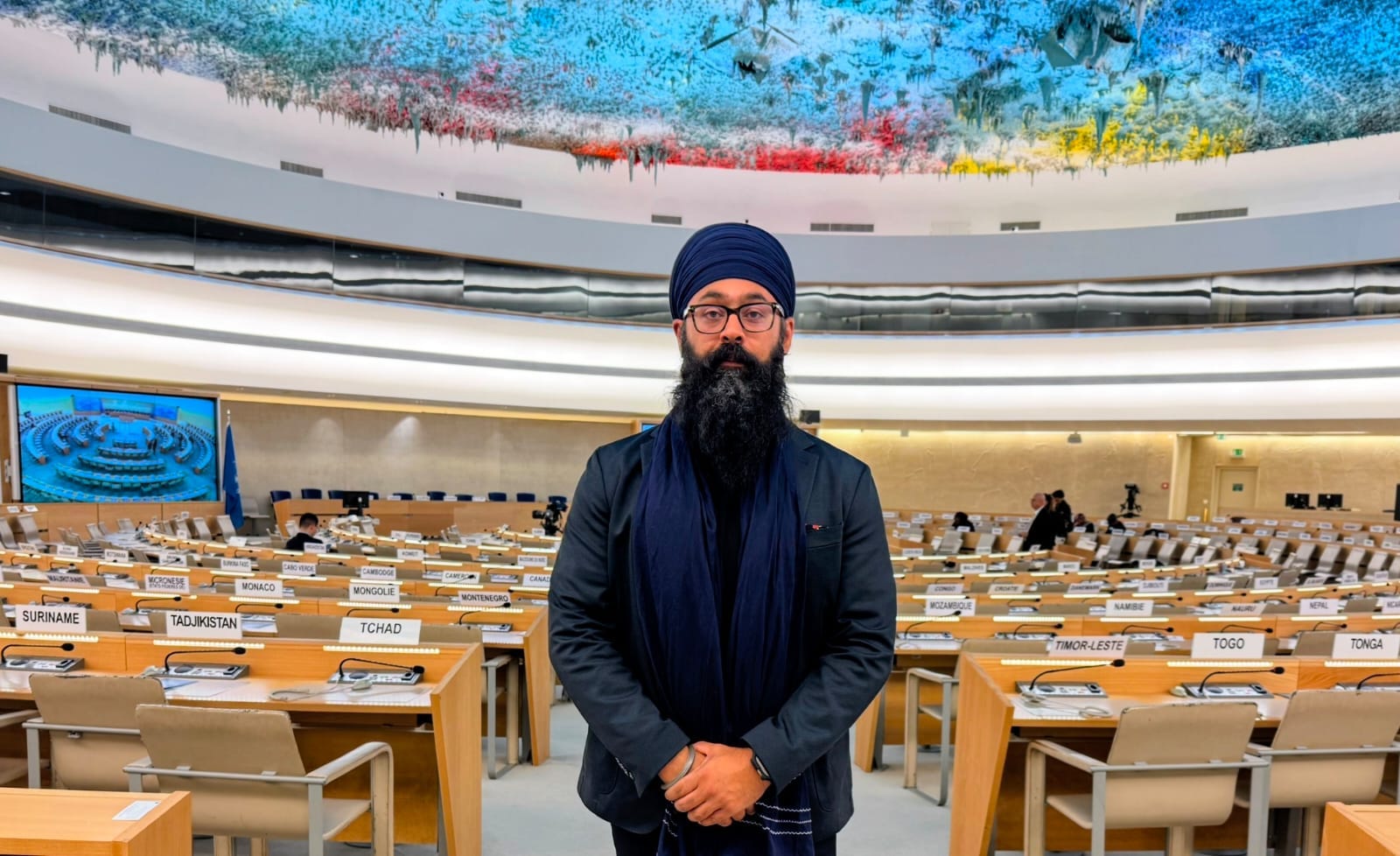
Balpreet Singh
August 11, 2026 | 6 min. read | Analysis
On June 3, 2026, five independent United Nations human rights experts jointly wrote to the Government of Canada concerning credible threats against Bhai Moninder Singh Bual, a Canadian Sikh activist and human rights defender. Their communication, identified as AL CAN 3/2026, documents a troubling chronology, places the threats within what the experts call a broader pattern of transnational repression by Indian authorities, and sets out Canada’s legal duty to protect those at risk.
Weeks later, in a Global News report, a second document made the abstraction concrete. A classified Canada Border Services Agency (CBSA) intelligence report, portions of which became public through the courts, set out in the government’s own words how the threats the UN describes are carried out on Canadian soil. Read together, the two tell one story.
The chronology is alarming.
Moninder Singh received his first duty to warn notice from Canada’s Integrated National Security Enforcement Team in July 2022. According to the UN communication, Sikh activist Hardeep Singh Nijjar received a similar warning on the same day. Eleven months later, Nijjar was assassinated outside the Surrey Gurdwara where he served as president.
Moninder Singh received a second warning in August 2023 and a third on March 17, 2025, shortly after returning from the United Nations Human Rights Council. The fourth arrived at his home on February 22, 2026, and for the first time extended to his wife and two children, with police reportedly assessing the intelligence as serious enough to warn of a credible and imminent plan to assassinate the whole family. Two days later, he was scheduled to address the 61st session of the Human Rights Council.
The pattern was serious enough for five UN experts to warn that the threats may constitute unlawful intimidation and reprisals tied to Moninder Singh’s cooperation with United Nations human rights mechanisms.
This is critical. Reprisals against those who engage with the United Nations do not only violate the rights of the person targeted; they attack the integrity of the human rights system itself. If activists can be threatened for bringing allegations before the UN, others will fall silent. This chilling effect is not incidental to transnational repression; it is one of its primary objectives.
If the UN letter tells us that this is happening, the Bishnoi files tell us how.
The Lawrence Bishnoi gang is an India-based criminal network, with links to the government there, that Canada listed as a terrorist entity in September 2025. Its founder has been imprisoned in India since 2015, yet according to the CBSA he has directed his organization’s expansion into Canada from behind bars. A tactical guide circulated to immigration officers in December 2025 describes its growing operational presence and its use of recruits to carry out extortions, shootings, and killings against Sikh Canadians.
What makes the report significant is not the catalogue of violence, but what the CBSA says about who the violence serves.
Canadian authorities have accused Indian diplomats of sharing information about government critics with the Bishnoi network, which is alleged to have carried out Nijjar’s assassination; the RCMP has separately assessed that the gang has acted on behalf of the Government of India. In the CBSA’s own careful language, these allegations suggest a potential overlap between organized crime and state-linked actors pursuing parallel objectives.
This is the heart of the matter.
Transnational repression is often subcontracted: a government supplies the targets and the intelligence, a criminal network supplies the gunmen, and the distance between them lets the state deny involvement while the threats continue. The report notes that the gang’s earlier violence focused on the pro-Khalistan movement and government critics, an alignment of criminal targeting with political dissent that is hard to explain as ordinary organized crime.
This is no longer an allegation alone.
On July 7, 2026, the United States unsealed an indictment charging Bishnoi and his lieutenants with racketeering, and charging Bishnoi and his top Canadian operative with ordering Nijjar’s assassination. The man Canadian police warned on the same day as Nijjar remains alive. The man warned alongside him does not.
Moninder Singh himself has framed the issue with precision. The central question, he has said, is not simply how the Bishnoi group operates in Canada, but how Indian intelligence and diplomatic officials have used that criminal network to surveil, intimidate, extort, and attack Sikhs in Canada.
The UN experts reached the same conclusion by a different route, warning of the misuse of counterterrorism narratives to justify targeting dissidents, minorities, journalists, and human rights defenders. That concern is acute for Sikh activists, whose advocacy for self-determination or Khalistan is lawful political expression in Canada. Canadians do not lose their rights because a foreign government finds their views objectionable; the purpose of those rights is precisely to protect expression that governments may strongly oppose.
None of this is unknown to Ottawa.
In October 2024, the RCMP publicly disclosed links between agents of the Government of India and serious criminal activity in Canada, citing more than a dozen credible and imminent threats against the Sikh Canadian community, and the Prime Minister said Canada had clear and compelling evidence of clandestine information gathering, coercion, and violent acts including murder.
At the 2025 G7 Summit under its own presidency, Canada led G7 leaders in condemning transnational repression as a threat to national security and sovereignty. It cannot now treat as an inconvenient diplomatic issue what it has itself called a threat to that sovereignty.
These obligations are legal, not merely political or moral.
Articles 6 and 9 of the International Covenant on Civil and Political Rights require Canada to protect individuals from reasonably foreseeable threats to life, whether they originate from governmental or private actors. Four warnings to Moninder Singh, and intelligence establishing how the network operates, mean that foreseeability is no longer speculative.
Obligations can be engaged even where a loss of life has not yet occurred; waiting for an attack before treating the matter as a rights violation would defeat the purpose of the duty to protect. A warning may be one preventive measure, but it cannot discharge the full obligation, which also requires investigation, accountability, and prevention of recurrence.
National security work may require operational secrecy, but secrecy cannot become institutional silence. Canadians are entitled to know whether the networks responsible are being disrupted and whether those who direct, finance, or carry out this activity, including any officials who enable it, are being held accountable. The experts have called on Canada to take all necessary interim measures to protect the family while investigations continue, and those investigations must follow the evidence wherever it leads, including to the state actors the CBSA itself has identified as operating in parallel with the gang. Where the evidence supports charges, prosecutions must follow; where foreign officials or institutions are implicated, there must be diplomatic consequences.
This is particularly urgent as Canada under PM Mark Carney rebuilds its relationship with India and pursues expanded trade ties.
Diplomatic engagement may not be inherently wrong, but engagement without accountability quickly becomes normalization. If Canada advances trade negotiations while the protection of targeted Canadians and the investigation of foreign-directed violence remain unresolved, it sends a dangerous message: that transnational repression carries no lasting cost.
The safety of Sikh Canadians cannot become a bargaining chip.
Any meaningful reset with India must include verifiable cooperation with Canadian criminal investigations, an end to the targeting of Sikh activists, and accountability for those responsible; otherwise, normalization will not restore the rule of law, but reward impunity.
There is a lesson, too, in how this network took root: officials acknowledge that gaps in immigration screening let the gang establish itself and recruit here, a reminder that protecting targeted communities and securing the systems foreign actors exploit are the same obligation, not competing ones.
For Sikh Canadians, this is not a theoretical debate about foreign policy.
Families have been warned that their lives are in danger, and a Canadian citizen who received a warning in July 2022 was assassinated within a year. The intervention of five UN experts, arriving alongside the CBSA’s classified report on the Bishnoi Gang, has again placed Ottawa formally & publicly on notice about India’s transnational repression.
It must protect those at risk, dismantle the networks responsible, and pursue accountability without allowing commercial or diplomatic considerations to interfere. The UN has said that transnational repression requires zero tolerance and full accountability. Canada must act accordingly.
Balpreet Singh hails from Toronto, Canada, and is the spokesperson and legal counsel for the World Sikh Organization of Canada.
Baaz is home to opinions, ideas, and original reporting for the Sikh and Punjabi diaspora. Support us by subscribing. Find us on Twitter, Instagram, and Facebook at @BaazNewsOrg. If you would like to submit a written piece for consideration please email us at editor@baaznews.org.