

Parneet Virk
April 21, 2026 | 5 min. read | Opinion
I have been going to the Surrey Nagar Kirtan since I was a kid. For many Sikh kids from Surrey, it is one of those days you grow up with. You remember the crowds, the food, the floats, the feeling of being part of something much bigger than yourself. There is a real sense of pride in seeing half a million people come together to mark Vaisakhi and the creation of the Khalsa.
That pride is still there. But the event does not feel the same.
The Nagar Kirtan has always been political in a real sense. The creation of the Khalsa was itself revolutionary, and the diaspora has long used this space to reflect on issues that matter to the panth. You see it in the memorials for 1984, in conversations around Khalistan and self-determination, and in the many other Sikh causes that people choose to highlight. That is not a problem. It is part of what makes the event meaningful.
But what feels different now is who else is showing up, and why.
When I went this year, the first thing I noticed was the scale of everything around the margins. Police presence was significant, including departments from outside Surrey. Political parties were out in full force, trying to start conversations while people were just walking through. There were corporate booths, branded setups, recruitment tents, and even people trying to pitch Costco memberships and services. At one point, it felt like you could not walk more than a few steps without being approached by someone selling something, promoting something, or trying to extract something.
It gave the event a different energy. Not hostile, but gentrified in a way that is hard to ignore once you see it.
There is a difference between being present and taking advantage.
The Nagar Kirtan is built on seva. It is one of the few large-scale events that is entirely organized, run, and cleaned up by volunteers in a matter of days. It reflects values like humility, equality, and collective care. Langar is served to everyone without question. That openness is part of what makes it powerful.
But openness should not mean that anything goes.
When corporations treat the event like a marketing opportunity, or when political actors treat it like a convenient place to engage voters, something is lost. It starts to feel less like a community gathering and more like a space that others are trying to tap into for their own purposes. Representation on its own is not enough if it is not grounded in respect for what the event actually represents.
That same lack of respect showed up online.
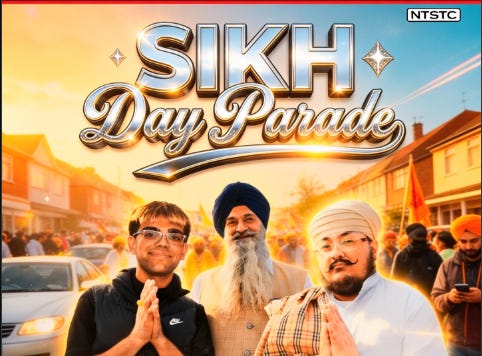
A recent visit by streamer N3on, alongside a Sikh content creator, Parmveer Singh Panesar (parmvsthewrld), was a clear example of how quickly things can go wrong. What should have been an opportunity to learn about the significance of the Nagar Kirtan turned into content that was built on misunderstanding and reaction. Repeated references to the event as an “Indian festival” and other dismissive comments made it clear that there was no real effort to understand what was taking place.
The problem does not end there. Clips from that stream are now circulating on platforms like TikTok and Twitter, often picked up by accounts that push anti immigration and anti Sikh narratives. In that context, what might have started as careless commentary becomes something more harmful. It feeds into a broader pattern where Sikh spaces are misrepresented by people who do not understand them and are not invested in getting it right.
We have seen this before. Whether during the Farmers’ Protests or in other moments, there have been clear efforts, both coordinated and organic, to distort how the Sikh community is perceived. That makes it even more important to be aware of who is speaking about us and how.
The Nagar Kirtan is one of the most visible expressions of Sikh life in Canada. It carries the weight of history, memory, and identity. It is not just a large event. It is something that has been built over decades through the effort of people who care deeply about what it represents.
So it is worth asking some uncomfortable questions.
Who is benefiting from this space? Who is shaping how it is understood by others? And what responsibility does the community have in setting boundaries around that?
None of this is about closing the event off. The Nagar Kirtan should remain open. It should continue to welcome people from all backgrounds. But there has to be some level of discernment. People and organizations that choose to be part of this space should do so with an understanding of its meaning and with a level of respect that reflects that.
At the same time, the community needs to take more ownership over its own narrative. Too often, the story of Sikh spaces is told by outsiders. If we are not intentional about how these stories are shared, we leave room for misrepresentation to fill the gap.
The Surrey Nagar Kirtan is not a place to cash in. It is not a backdrop for content. It is not a marketplace.
It is a reflection of the Sikh community, its values, and its history.
And it deserves to be treated with that level of care.
Parneet Virk holds a Bachelor of Arts in Sociology and Asian Studies from the University of British Columbia and a Master of Arts in Social and Public Policy from the University of Leeds. Her academic work, including her graduate dissertation, has focused on the Punjabi Sikh diaspora and its social and political dynamics.
Baaz is home to opinions, ideas, and original reporting for the Sikh and Punjabi diaspora. Support us by subscribing. Find us on Twitter, Instagram, and Facebook at @BaazNewsOrg. If you would like to submit a written piece for consideration, please email us at editor@baaznews.org.
Khalistan arose organically as a response to Indian oppression.
1. When all other states were organised on language basis, Punjab was refused. Saying Punjabi Suba Zindabad was made illegal. The same people who hate the idea of Khalistan today, are the same people who would have opposed Punjab even being a state with Punjabi as a language.
2. During the 1966 Asian games, Sikhs were searched and beaten on their way to Delhi. Only Sikhs.
3. During Indira Gandhis dictatorship, known as the emergency, Sikhs refused to comply with her violation of the Indian constitution.
By the same token , why politicize the event. These so called “Khalistanis” are good for nothing political wannabes who only help fuel hatred and contempt. Given that 99.99% Sikhs are against any such separatist , violent right wing ideologies , Why do khalisantis hijack every such community event forcing the entire community to be maligned We should not allow such futile , ill conceived politician ideas. “Self determination” is a tall order for a community who can barely manage even a simple gurdwara : we literally hit the headlines with “2 factions attack each other in gurdwara”. Name any Sikh run business that has not fallen apart within a few years . What is the pint of having a Nagar Kirtan when thisni clearly not a tradition ? Other minority communities don’t need such street shows because their achievements speak for themselves. Well respected professions , industry leaders , academia, reporters , intellectuals. High ranking Military officers, national level politicians. What have we done ? Allowed semi literate pendu-mindset folks to the fore ??